

Closing The Book On The UAP Disclosure Cult
An essay series is now a completed book project
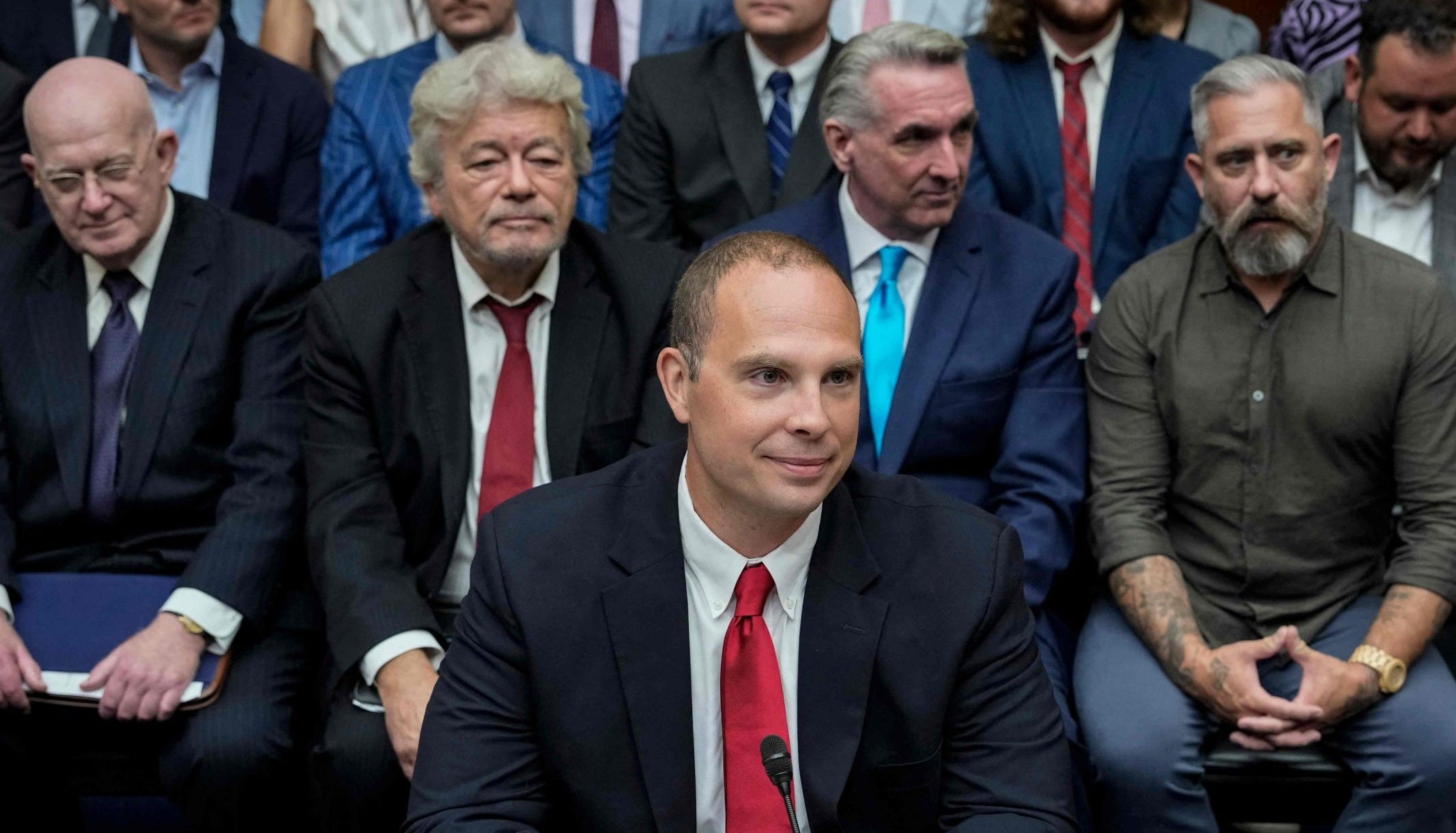
In photographs taken just before the June 2023 hearing, he sits at the witness table with a crescent moon smile, fingers folded, folder open, notes ready. David Grusch, former National Reconnaissance Office Representative of the Unidentified Anomalous Phenomena Task Force at the U.S. Department of Defense, sits flanked by Ryan Graves, executive director of Americans for Safe Aerospace to his right, and retired Navy Commander David Fravor to his left.
Whereas the men on either side of Grusch never used the words “aliens” or “extraterrestrial” in their testimony to the U.S. House Subcommittee, Grusch dared to speak of “non-human biologics”, of crashed and recovered spacecraft. The evidence definitely existed, Grusch told Congress, though he could not discuss any details, which were classified. He had not seen the real evidence himself, he had only heard about it from other people. Grusch was accusing the United States government of a decades-long cover-up based on hearsay. My forthcoming book explains how that happened.
While the hearing drew worldwide attention, Grusch’s remarks to the Sol Foundation in December that same year got far less media coverage. Organized by the controversial Harvard scientist Avi Loeb, the Sol Foundation held a virtual conference focused on the phenomenon of UAPs, or unidentified aerial phenomena. In his keynote speech to close the event, Grusch told attendees that “the release of information on non-human intelligences has the potential to unite humanity in a shared quest for understanding, regardless of the ontological shock.”
Everyone will be so shocked that flying saucers are real, world peace will break out spontaneously. Human beings already believe different things about the same gods, and Grusch does not explain why we would treat flying saucers in a different way. He seems to assume that things will work out as they are supposed to, as they were designed to work out. By simply “unlocking these truths that lie beyond our current public understanding,” the revealed spacecraft-gods will necessarily revolutionize all human beliefs, wiping out every difference of opinion in a single world-historical instant. We will all suddenly live in perfect harmony.
“The acknowledgment of otherworldly intelligences challenges our very concept of existence, encouraging us to reconsider our place in the grand tapestry of the universe,” Grusch said. A lapsed Catholic who had returned to ‘spirituality’ by the time of his testimony, just months after his congressional testimony, Grusch expected this future acknowledgment of extraterrestrial beings and technology to provide “an important and profound introspection and a catalyst for a new era of spiritual awakening.”
When the aliens and their spaceships are disclosed, Grusch says, it will be a “paradigm shift that holds the power to reshape our world.” For “by embracing the unknown, we open ourselves to a world where truth, unity, and technological advancement and a deeper understanding of our existence converge.” The result will be “a more enlightened and interconnected world.” Peace on earth will come with universal goodwill towards mankind.
Grusch asked attendees to “imagine a future where we no longer need to speculate about our place in the cosmos” because we will be able to visit the cosmos in person, in our new flying saucers. Rather than a scientific commentary, Grusch witnessed to his faith in these new technologies to rescue us from our drab, terrestrial mortality. “No longer bound by the limitations of national borders, we would embark on a collective journey of discovery transcending political differences and fostering a sense of global unity” with our newly-revealed flying saucers.
“The realization that we are not alone in this vast universe could serve as a powerful catalyst for international cooperation, reminding us of our shared destiny as inhabitants and stewards of the earth.” Speaking for all of humanity — because he is convinced that all of humanity will naturally follow him into this wonderful future — Grusch declared that “we as a society are ready to confront the unknown and unravel the mysteries that have perplexed us for decades.” Humanity is one society under the heavens, ready to live in harmony.
By “decades”, Grusch was referring to the era of UFO sightings, but in fact the “mysteries” that perplex him have also perplexed American spirituality for centuries, since at least Revolutionary times and the founding of the nation. What Grusch calls “disclosure” is in fact a species of Dispensationalism, the 19th century Protestant idea that a new, permanent epoch of peace on earth is immanent. As we shall see in this book, the Aquarian New Age mimics Christian Dispensationalism even when it completely abandons Christ. For, you know, harmony.
Sydney Ahlstrom, the great scholar of American religious history, would recognize this as Harmonialism, a form of religion that “encompasses those forms of piety and belief in which spiritual composure, physical health, and even economic well-being are understood to flow from a person’s rapport with the Cosmos.” In Harmonialism, the believer seeks communion with the infinite to achieve beatitude and immortality, otherwise known as peace and well-being. In his monumental work A Religious History of the American People, Ahlstrom identifies “charismatic founders, complicated institutional structures, secret doctrines, or elaborate rites and rituals” as characteristics of Harmonialism. We will find all of these in the Disclosure cult.
The Harmonialists produce scriptures and cultures of “allegedly rational argument, empirical demonstration, and (when applicable) a knowledge of the ‘secret’ meanings of authoritative scriptures.” Harmonialists frequently claim to have “an ancient lineage”, while “even those of very recent origin show similarities with the syncretistic religions that were challenging Judaism and Christianity two decades ago”.
David Grusch is a new priest of an old time religion that has experienced countless schisms in the febrile tension between liberalizing, universalizing humanitarianism on one hand and the limiting features of Christian orthodoxy on the other. Every UFO prophet presents a revised Christ, an admixtured Jesus, in hopes of bringing humanity together in unity — harmony — as liberal Christianity has failed to do.
Harmonialists always reinvent the Christ story, and re-cast the image of the Son of Man according to current fashions and tastes, which inevitably change again, being fashions and tastes. Every iteration of what I call “Space Jesus” thus fades with time, requiring a new prophet to refresh the old religion.


During his lifetime, Claude Lévi-Strauss, a French-speaking Belgian scientist, developed a theory of structural anthropology in which figures like David Grusch remix religious elements and revitalize spiritual movements. Using Straussian terminology, this book project regards Grusch as a bricoleur, a myth-maker who combines new and old cultural materials to create, or re-create, structures and meanings. Every bricoleur forms their own pastiche from a ‘menu’ of beliefs, or bricolage.
In this series, we have observed the history of a belief that has changed its outer form many times, always dressing up in science, only to see our scientific understanding of the universe change, dating their work until it is passé. Forced to rationalize the new-found flaws in their scriptures, the believers in extraterrestrials always innovate. Modernity made science the final arbiter of epistemic truth, of what is real and what is not, so the next iteration of belief in extraterrestrials will always present itself as more scientific and rational than the last.
As we have seen in this series, the flying saucer is an example of this phenomenon. With the reputation of Theosophy at an all-time low after World War II, the practitioners of what we now call “New Age” Harmonialist religion re-branded their old beliefs with a flying saucer, which they deemed more scientific and rational in the nuclear age than communion with extraterrestrials through the old ways. The UFO has become a ‘way of knowing’ among moderns.
Once nuclear rockets were possible, astral travel, channeling, automatic writing, and séances became embarrassments, too obviously magic, whereas scientific language offered new potential for magical explanations. As Arthur C. Clarke famously observed, a technology may be indistinguishable from magic if the observer lacks a background understanding of the technology. As L. Ron Hubbard demonstrated, many moderns yearn for a “spiritual technology” that brings them into harmony with a god that is scientific.
This essay series did not engage the scientific debate over alleged evidence of extraterrestrial visitation, contact, or abduction beyond its limited remit. Per the title, the book project growing out of this series is a spiritual biography of the belief in extraterrestrials — a history of people believing in extraterrestrials. It is in that sense a skeptical history, making sparing, but significant use of writings by skeptics to buttress the argument that the flying saucer is an icon of a spiritual movement. Primarily focused on the United States, where flying saucer religion was born, the book draft examines the phenomenon in its most concentrated form, globally: the cult of believers.
While the word “cult” always inspires believers to resist the application of the word to their own lives, in this book project, it is used in its neutral sense, referring to a group of believers, with or without a leader. If I were to use the phrase “the cult of the extraterrestrial”, I would simply name the whole universe of believers, including those who would never join a cult, but who do keep the mystery of the extraterrestrial alive in their hearts.
Very few people who express any measure of belief in extraterrestrials will ever join an actual cult, just as very few Christians will ever join a Christian cult, but all Christians belong to the cult of Christ. This book drafting essay seriews is not an attempt to start a moral panic about cults or convert anyone to any belief, or to disbelief. I have written an exposé of a belief that presents itself as scientific when it is not, that cannot be honest about itself to the world or build open communities of faith with lasting structures, so it lives inside the structures which already exist. As science and technology are key concerns of the modern United States government, that is where it lives.
I do not suggest that belief in extraterrestrials will inevitably lead anyone to join a cult, one day. Cults are the most intense groups of believers associated with any faith tradition, so UFO cults are worthy of study. Furthermore, the effort to create and sustain a cult usually involves the production of a scripture, or at least a canon of literature. It would be impossible to study the topic of spiritual belief in extraterrestrials without examining the texts that believers create in their efforts to found new religious movements, aka cults. Nor can we separate the application of the beliefs presented in the text from the activities of the cult based on those beliefs (“praxis”). To understand the belief at its most intense, we must study the cults.


The vast majority of this book project is the words of believers themselves, verbatim, or through the most accurate and relatable paraphrasing I could manage. I have invented nothing. What follows is an accurate description, to the best of my ability, of what the believers say they believe, contextualized by historical facts, such as publication dates, to show how each generation of bricoleurs inspired the next generation to innovate, until David Grusch appeared before Congress.
Rather than argue whether extraterrestrial aliens exist, this essay series is about the history of the belief in such beings. Believers in extraterrestrial beings existed before science fiction existed, indeed Chapter 1 will argue that Harmonialist belief inspired science fiction rather than the reverse. The extraterrestrial on page and screen has always reflected beliefs about extraterrestrial aliens that began as revealed spiritual experiences, while the believers have in turn reflected and amplified the science fiction that they read and watched, transforming fiction into revealed spiritual belief. This is the bricolage effect of Lévy-Strauss and Donager in action. In her 2016 book Strange Rites: New Religions for a Godless World, religion reporter Tara Isabel Burton prefers to call this activity “remixing”. We have observed the bricoleurs doing this over and over again in this essay series.
Some aspects of culture are badly underserved in this work, such as comic strips and comic books, which are mentioned in passing during my discussion of the early movie screen. Students of pop culture history are encouraged to react to this work and expand from the premise contained here. I expect a lively debate among those scholars about Chapter 5, in which I discuss the forgotten impact of Theosophy on Depression-era America, tracing a possible imprint of one particular cult on the Star Wars universe of George Lucas.


Figures like George Adamski, the world’s first UFO “contactee”, and his protégé-turned-rival, George Hunt Williamson, explain the shamanistic pronouncements of Carl Jung, who says that UFOs are spiritual objects, as well as the pseudoscientific language of Jacques Vallée, who says that UAPs are a form of artificial intelligence from another dimension.
Readers will learn how the new cult of the UAP has once again refreshed the bricolage of Harmonialism through the invention of a new spiritual Mecca at Skinwalker Ranch through the History Channel, and see that this new “Cult of Disclosure” is not so very new, after all. Ahlstrom would recognize it as Harmonialism, primarily because so many people in the Cult of Disclosure are mediums, remote viewers, or other psychics — the very people who communed with extraterrestrial beings for centuries before the first flying saucer reports. Half of this history takes place before the Second World War, half after. This ambition places A Spiritual Biography of the Flying Saucer solidly into the category of long durée historical narratives.
My narrative of the cult of UFO ‘disclosure’ begins with a full disclosure of the author’s own biases. In 1982, my uncle, then 20 years old, felt an urge to sit up and look out of his bedroom window in Lake Point Tower, Chicago. He told the family later that he observed an invisible object, or rather the hole that it created in the foggy Lake Michigan sky, and sensed that it returned his gaze before rising into the sky and disappearing.
That Christmas, he gave me a book we have met in this series, UFO: Contact With The Pleiades. One year later, my uncle was hospitalized for the first time with mental health issues, including delusions and hallucinations. It was the beginning of my lifelong journey towards skepticism, fascinated but wary of the extraterrestrial visitors in the exciting stories I read. It was the beginning of my uncle’s lifeline disintegration and institutionalization. He was never violent. Indeed, he developed a profound, gentle spirituality that gives him comfort that heaven awaits and all is right with the universe.
Sometime around 1983, I was interested to find a section of books on supernatural mysteries and spooky stories in the Kilby Elementary School library. Among these was Alien Meetings by Brad Steiger, a 1978 anthology of reputed encounters with extraterrestrials. Opening the book, I found the Vegetable Man. While out hunting in West Virginia, a hillbilly named Jennings Frederick supposedly encountered a slender, green, telepathic being from another planet that resembled a stalk of celery.
The story struck me as outrageous, for I had already watched “The Great Vegetable Rebellion”, the infamous 23rd episode of Season 3 of Lost In Space. In this silliest of episodes, Dr. Smith is transformed into a giant stalk of celery by a carrot-man villain, Tybo. The rest of the Jupiter 2 crew are likewise threatened with transformation into trees and vegetation. Much later, I confirmed that the episode first aired on 28 February 1968, the same year as Steiger’s ridiculous story. My skepticism was earned with critical thinking that started early.
Flying saucers seemed to have waned by the 21st century. But in 2017, a sensational New York Times article brought them buzzing back into our national consciousness. Every wave of UFO sightings is called a ‘flap’, and the flap that followed the NYT story definitely peaked with Grusch’s testimony and the resulting letdown. When House and Senate committees convened to discuss the “UAP” issue in November 2024, hardly anyone even attended. Both hearing rooms were almost empty of reporters or interested members of the public.
But even then, it was clear that the cult of Disclosure was not giving up, that the Harmonialists were going nowhere. As we have learned, a surprising number of these people are not outsiders, and none of them are counterculture radicals, indeed too many of them are careerists of the ‘deep state’.
“‘They’ have been here for a very long time”, Deep Throat, the mysterious informant in the first season of the X-Files tells FBI Agent Fox Mulder. Of course, the character played by legendary actor Jerry Hardin was referring to the extraterrestrial aliens at the core of the show plot. In the real world of the mundane, however, ‘they’ are the Harmonialists, they have always been here among us, and our federal government has provided the laboratories where its myths have been subject to gain-of-function research.
Four prominent individuals sat directly behind Grusch as he testified. Two of them are deep state careerists, while the other two are media figures whose reputations now stand on flying saucer documentaries. The closing essays in this series have established their Harmonialist bona fides, tying them all to a spiritual movement that conceals itself behind the secrecy regime of classified technology development.


David Grusch gave his most revelatory testimony to podcaster Joe Rogan in episode #2065, published on 27 June 2024. According to Grusch, he found the cult of Disclosure on his own, for he was a seeker of the Harmonialist faith. “In 2018 I started doing kind of what I call my open source review, like, let me spin myself up on this topic, watching Chris Mellon, Lou Elizondo, Leslie Kean, all these people talk about the subject”, he told Rogan. Then in 2019, his supervisor at the National Reconnaissance Office shared a recruiting email from the “UAP task force director”.
He blew the whistle, he says, when he looked for the extraterrestrial deep state program and did not find it. Rather than disconfirmation, Grusch relied on the word of a person with “academic credentials which were beyond reproach, you know, PhD level education” with an “insane” resume”, which sounds like Christopher ‘Kit’ Green.
As we have seen, Green refers the believers to Richard Doty, who has been making up stories for decades. It is an argument from expertise that attempts to rationalize away the total absence of evidence with hearsay from suspect sources. Grusch also names James Lacatsky, a scientist “who ran this program” and became “personally aware of intact vehicles and everything”, as the authoritative source on them.
Having been referred to this person by the Skinwalker Ranch group, Grusch met him in a “top secret facility” where “he started to discuss, like, hey, there’s a program, I was on it”. They were telling Grusch “because you guys have to report to the Secretary of Defense and Congress on this matter”, prevailing upon him to deliver his faith testimony to the United States government.
Of course, Grusch would have us believe he was skeptical. “I don’t take a guy’s word for it,” he told Rogan. Along with unspecified colleagues, Grusch “cultivated our network and we ultimately interviewed about 40 people or so, all the way up to multi-star generals, directors of agencies, mid-level guys that literally touched” the alien spacecraft, “worked inside of it, all the stuff they brought, intel reports for me to look at, you know, documents, and a lot of that I could cross-verify with other oral sources that my high-level colleagues or I talked to”.
The community of believers within the deep state was reinforcing Grusch’s belief in the existence of a special access program. This circular citation scheme “checked out”, Grusch says confidently, allowing him to demand access to special programs that he was sure existed. When he was denied access to programs that did not in fact exist, that had never existed, Grusch blew the whistle, and became the most prominent confessor of Harmonialist faith in our time.
Mr. Grusch also got to visit with the late Sen. Harry Reid in Las Vegas “about nine months before he died” so he could “get his thought leadership on it”. This pilgrimage to the most powerful Disclosure cult believer, the man who had secured taxpayer funding for Robert Bigelow’s paranormal research at Skinwalker Ranch, ostensibly to study UAPs, seems quite meaningful to Grusch.
“So I’m sitting there in Harry Reid’s living room, you know, right next to him with some other witnesses that were there with me, and he straight up says ‘Yeah, I knew ew had UFO material. I was denied access for decades’” — the same fruitless search that Grusch had made. “I have Harry Reid literally saying ‘Yes, we have material’, and you know, he knew it was non-human”. He knew, despite having never received access, and this is good enough for David Grusch.
During the same podcast, Grusch also revealed his own spiritual outlook. Near-death experiences contain a “message of love” and “interconnectedness” where “everybody is kind of connected in a way that they don’t really realize”, he told Rogan. Grusch speculated that humans might all be part of a higher-dimensional sentience. Our lifespan might be a “weird 3-D plus time temporal sensory experience” to gain knowledge and “report back” to this higher dimension.
Interconnectedness, universal consciousness, cosmic forces fostering spiritual serenity and ontological understanding: this is the Harmonialist gospel. Consciousness is our bridge to higher realities — our spiritual technology.
Referring to the border science of Garry Nolan, one of Bigelow’s team of border scientists at Stanford, Grusch described the caudate putamen of the brain as a possible “transceiver” of thoughts from higher spatial dimensions. Perhaps this is an “emerging property of human beings as we evolve” to the level above human. In Spiritualism and New Thought religion, mental attunement to the cosmos enables psychic abilities and personal spiritual growth. Grusch is singing from a Harmonialist hymnal.
Humans might be “created in the image of a creator literally,” Grusch says. Emanuel Swedenborg would be so proud that his doctrine of correspondences lives on. Rather than dwell on the obvious outer contradictions of religion — the “divisiveness” that makes one religion different from another — Grusch would explore deeper existential questions that unite humanity in rapport with universal consciousness.

Joe Rogan is the world’s most popular podcaster. His program is least as influential as the History Channel — or Coast to Coast, the nationwide AM radio program started by Art Bell in 1989 that syndicated in 1993. Coast to Coast began on KDWN, an AM radio station in Las Vegas. George Knapp, a local television journalist with KLAS-TV in Las Vegas, raised his national profile as a weekend radio show host. As we have seen in this essay series, Knapp was an original member of the Bigelow group, and frequently invites its principal characters to appear on the show.
Now 75, Knapp also requires replacement by a new generation of presentational pastorage. Rogan, 58, was the right age for Harmonialist enlightenment during the recent UAP flap. His show has also featured Graham Hancock, for example. I could have written an entire book equal to the length of A Spiritual Biography of the Flying Saucer just to explain the Harmonialism of Hancock.
However, we need only recognize here that Hancock’s constant and relentless refrain is that academic scientific archaeology refuses to engage the study of “consciousness”. In his writings, he speculates about spiritual technologies that were known to prehistory, that were lost to history, as if human beings learning to write things down made us forget them.
Whereas scientific archaeology reconstructs the methods by which humans moved very large, heavy things into place with increasing precision all the time, Hancock has yet to demonstrate a spiritual technology that can build pyramids, position the moai heads of Easter Island, or construct Olmec walls. The story he tells is a refurbished version of the same genesis story that Harmonialists have built on lost continents since the 19th century.
Arthur Davis Jackson’s The Harmonialist Philosophy was published in 1917 after his death. It is the work from which Sydney Ahlstrom takes the name he gives to the family tree of religions deriving from the root of Emanuel Swedenborg in the 1700s. Jackson’s book is a typical example of why the bricolage effect is necessary, for by the time it was published, the First World War was disrupting all thoughts of human harmony.
It was by then an artifact of an era that had just passed, that had been extinguished with the “lights of Europe”, but which left to us all the familiar tropes of pseudoarchaeology that Graham Hancock has refreshed in his new bricolage. He has learned to sound scientific and rational, but it is the same Harmonialism underneath the skin of science.
Problematically, actual scientific archaeology does in time examine the things that pseudoarchaeologists proclaim unexamined. The eventual results of these tests of epistemic fact invariably point to earthbound explanations. Rogan’s podcast is the biggest electronic pulpit from which the Harmonialists now preach their gospels. Because he considers himself to be rational and scientific, however, Rogan manages to keep this reality secret even from himself.
Rogan has likely never heard of Harmonialism. He would probably reject this thesis of this book, unread, because he does not see himself as a convert to a religion. Yet Rogan is a constant spiritual seeker, as he shows us all the time, while Harmonialism is a religion of searching, not finding. The extraterrestrials remain hidden from the masses so that we will continue to seek them, long for them, demand them, regardless of their material existence.
Being humans, we want to believe. We seek meaning in symbols. The flying saucer has a spiritual biography that is substantially evidenced, whereas it has never manifested as material evidence of alien visitation even once. The evidence presented to the world for scientific study consists of experience and interpretation, with the proponents of belief offering intangible explanations and esoteric rationalizations for what is missing.
The community of UAP ‘disclosure’ is a mystery cult. It has refreshed the bricolage of the former UFO mystery cult in our time, but it is the same old time religion. As my forthcoming book will prove beyond any doubt, Harmonialism has been a spiritual force in America since before the founding of the nation, influencing virtually every religion born within this nation’s boundaries. Belief in the extraterrestrial, in the lost world, in a past disconnection from the universe that requires repair to give us eternal peace, is old. “They” have indeed been here for a very long time.


Science Of The Soul: Theosophy, Therapy, And The Evolution Of The UFO Cults

Secret societies always have esoteric beliefs at their core. In his explanation of Freemasonry, Albert Gallatin Mackey attributes the foundation of his faith to Abe Dom Pernetty, “a Hermetic philosopher,” and “a disciple, to some extent, of Jakob Böhme, that prince of mystics. To such a man, the reveries, the visions, and the spiritual speculations of [Emanuel] Swedenborg were peculiarly attractive.”