

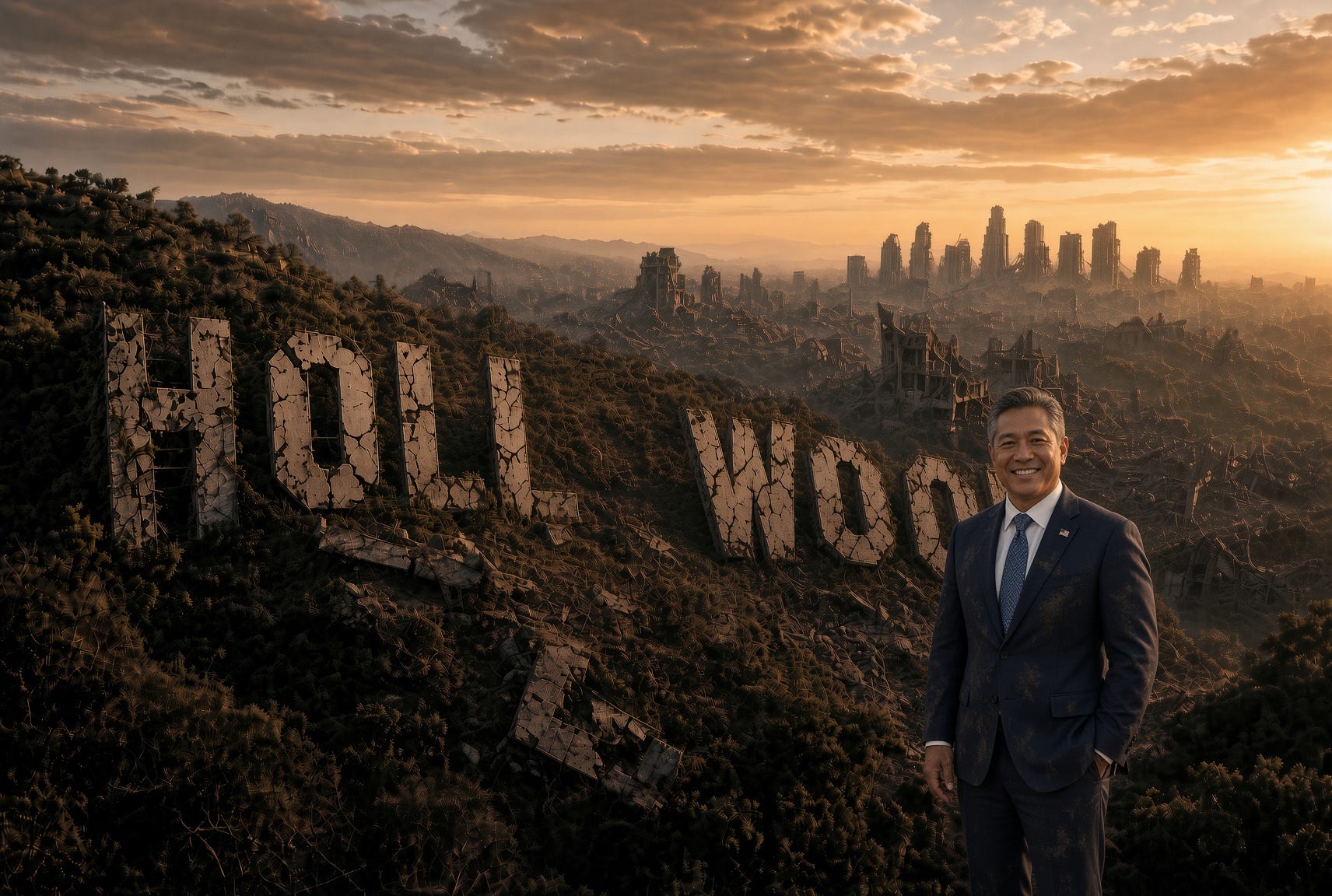
Archaeology will perhaps wonder, millennia hence, just what gods the people of southern California worshipped at a certain hill overlooking the former urban skyline. Based on the needle hazards they find in the destruction layer, those future scientists will likely speculate that worshippers all used intravenous drugs during some sort of mass pilgrimage.
Our future scientists must after all explain the midden layer of tents and sleeping bags, too. Evidence of fire destruction, followed by abandonment, will hint at some mysterious cataclysm. How did everything burn?
Most of the silent movies ever made are gone forever. Most of the ‘talkies’ that were ever made are also going to disappear forever, or else get Bowdlerized for streaming. Every creative property is subject to enshittification, the decay of content.
This reductive force of cultural re-creation — call if film entropy — means that our notional future archaeologists will struggle to assemble and interpret scraps, references, and clips the way 19th century epigraphers struggled to assemble shattered clay tablets.
Like the frantic final message of Ammurapi, the king of Ugarit, reporting the mysterious sea people(?) on the horizon, perhaps there will be tantalizing evidence in the ruin that Rob Bonta was responsible, at the end.
Bonta, the attorney general of California, leads a multistate legal effort to stop the merger and acquisition of Warner Brothers by Paramount. All twelve state attorneys general involved in this effort are Democrats.
This week, Bonta walked away from negotiations with David Ellison, the chairman and CEO of Paramount, whose long-contested acquisition of Warner Brothers has been cleared by the EU, the US government, and WB shareholders. Bonta wants the case to drag into next year, costing Ellison $7 million a day in contractual delays, per the terms of the merger.
Ellison wanted Bonta to agree to cover the costs when Paramount wins in the Supreme Court. The AGs of Montana and Iowa have now asked the Court to block Team Bonta, arguing that the merger is in the interest of their states. The legal picture remains complex and fluid, but few informed analysts give Team Bonta much chance of winning.
Delay seems to be the real strategy. Bonta’s motives are both political and personal. If Ellison acquires CNN, a beleaguered cable channel in a post-cable era, before November, he could complicate the midterm election plans of Democrats by putting Bari Weiss in charge. Of course, this is all speculative, but powerful people clearly doo perceive high stakes in the matter.
Netflix made its own bid for Warner Brothers, and is eager to see Ellison bleed, or even recover WB for themselves. Netflix would refurbish CNN, sell off the rest of the acquired assets, and maintain the studio lot in LA as a political plum. Not by coincidence, Patty Quillin, the wife of Netflix co-founder and former CEO Reed Hastings, is a major donor to Rob Bonta as well as his wife Mia Bonta.
Bonta says the case is about unlawful market concentration under antitrust law, the Clayton Act. Ellison says the case is about punishing his company for political purposes. In response, he stands ready to punish California by pulling up stakes and re-concentrating the movie industry in the American south: Austin, Atlanta, and Nashville are likely candidates.
Hollywood will not be missed immediately, but eventually, through the progressive degradation of film culture. The limited attention-spans of the first generation raised on ‘smart phone’ apps like TikTok will do the rest. Succeeding generations will note the decline in quality from previous generations, evoking nostalgia, but the past is a country we cannot visit.
By the time everyone remembers what was lost, Hollywood and its social values will be history, pronouns was/were.
The city made choices. Los Angeles long ago ceased to be a good place to shoot for any sort of screen. Potential sets are filled with homelessness and the hazards it produces, requiring heavier security. Red tape, an uncooperative city government, and union rules make content production so expensive in LA that it is cheaper to fly an entire movie crew and cast to a foreign country.
Sound stages are going out of business. The WB studio lot is probably worth more as real estate than as a studio. The movie business is the most people-intensive art form, as the credits to any film will attest. Everyone from writers to caterers to key grips has lost work in recent years. Many have relocated. Others have given up and found new careers.
Unions played a major role in the decline of Los Angeles production. The successive strikes after covid reduced production at exactly the wrong time. Better contract terms did not translate into better earnings because production never recovered. Both strikes deserve to be seen by historians as a massive mistake.
All of this weirdly resonates with Christopher Nolan’s The Odyssey, in which Matt Damon realizes that he and his men were the real sea people the whole time. Nolan’s film has made a comfortable profit, mainly through an exclusive four weeks in IMAX theaters. It was surpassed however in its third week by Spider Man: Brand New Day, which is on track to make $2.5 billion.
There is still money to be made in making movies, just not in Hollywood. Americans still want spectacle and entertainment in theaters, but they do not care whether the production was overseen in Hollywood or not. Artificial intelligence will reduce the number of creatives required to produce the same amount of content, and stories will be rendered more quickly. More to the point, this is all happening at once.
Eric Cline, eminent historian of the so-called Bronze Age Collapse, makes earnest and consistent efforts in every presentation to say that no single cause can explain everything.
Ugarit may have been sacked by the mysterious sea peoples, but other cities may have been burned down by their own citizens. Mycenean palaces definitely declined, but earthquakes seem to have played a role. A climate shift, possibly resulting from a volcanic eruption, may have caused agricultural peoples to leave their famine lands in search of better country.
Any one of these problems on its own would have been survivable for the economy of the late Bronze Age. All of them at once, together, reduced the network of elites until almost no one was left. Kings need the society of other kings to be seen as kings themselves.
When trade resumed after the ‘collapse’, it ran on new terms. Instead of centralized management from a palace, private merchants pursued profits on their own terms, while sovereigns focused on protecting merchants and collecting tax. A new economy replaced the old.
A similar story is now culminating in Hollywood. The decline of Warner Brothers took decades, but the sale of WB was the bill coming due for a decade of easy money. Global investment capital declined after 2022 due to the Russian war on Ukraine. On top of everything else, it was too much.
Rob Bonta is simply the agent of destruction that arrived in the middle of the mess to complicate the outcome and leave his name in the economic wreckage. Bonta wants power, so he aims to reshape the electorate of California even if it kills the state.
Political science calls this the Curley Effect. It is the same with Karen Bass, Nithya Rahman, and the political machinery that still holds back reconstruction almost two years after the Palisades burned. The damage is intrinsic to the project of creating and maintaining power. We cannot see the Curley Effect in the archaeology from Ugarit, but it was probably there.
On The Slow Self-Destruction Of The University

Nobel Prize recipient Dr. James Watson, the discoverer of the DNA double helix, was a genius in the true sense of that word. Still, Watson was destroyed personally and professionally for saying out loud that intelligence has a genetic variability linked to what we call ‘race’. In the western academy, it is a thoughtcrime to notice that genetic variation produces more or less desirable traits in human beings, or that evolutionary time in different environments will produce a variety of traits.