

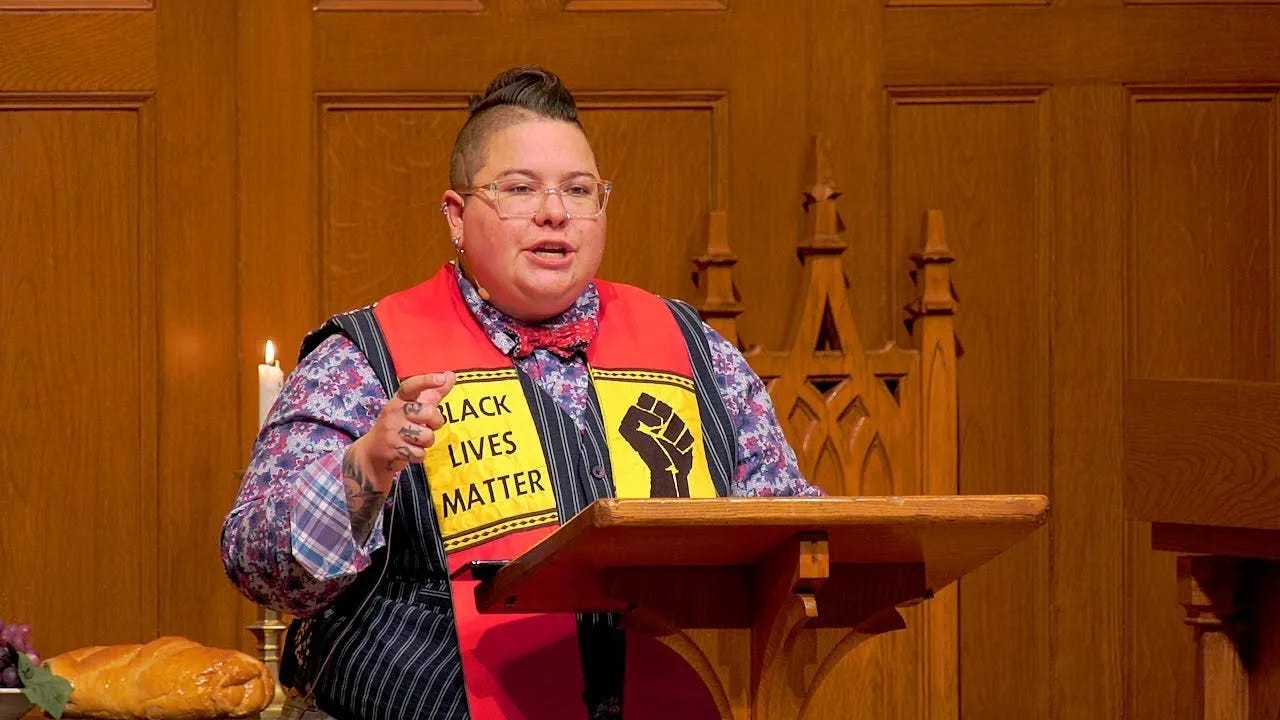
Roberto Henderson-Espinoza, a PhD scholar using he/they pronouns, identifies as Mestizaje, autistic, bi-polar, non-binary, transgender, and Latinx. She is all of the things, the most intersectional identity imaginable, in order to escape the “conditional whiteness” of her mixed parentage, the original sin that she rejects in herself.
Her white father was so racist that he told Henderson-Espinoza, PhD to disclose her ancestry on official forms, so that she could benefit from racial preferences in education and hiring. Robyn seeks escape from this painful consciousness of her own race as Roberto. “Especially now in the war against Black and Brown bodies, embodying whiteness on my skin has been the hardest journey of my life”, she writes in Body Becoming: A Path To Our Liberation.
This self-hatred “is the radical difference I seek to be connected with — the center of my own difference: conditionally white.” These words resonated with James Talarico, the very white Democratic US Senate candidate for Texas. After connecting with his favorite theologian on X in 2021, Talarico appeared on Henderson-Espinoza’s podcast to complain that “whiteness and masculinity” have limited his imagination.


In the ensuing podcast appearance, Talarico confessed (there is no better word) that he harbored doubts about electoral politics as the solution for change in Texas. He was considering seminary, he said, because we are “running out of time” due to climate change. Henderson-Espinoza described the task of politics as “help[ing]” Republicans “have compassion”, to which Talarico reverently responded, “Yeah”.
Henderson-Espinoza uses the word “compassion” a lot in Body Becoming. She takes it to mean “suffering with” someone, an exercise in empathy. Her activism asks us all to identify with her, and then through her, to identify with everyone. “Existential and survival questions that in one sense arise out of our particularities (for example, being Latinx, queer, and biracial) are shown to be deeply important at the level of universality”, she writes in Activist Theology.
Theology without Christ or God
“There is no theology without activism, and there is no activist without theology.” Her life is activism. Being queer, injecting queerness into the world, creates a theological “culture shift”, Henderson-Espinoza told Talarico in an uncanny, testosterone-affected voice. Nashville, her current home, was a place where she felt she could change things — not like Texas, her birth state, which “felt scary to me” as a “trans and queer person”.
Henderson-Espinoza’s theology is focused on liberation from “interlocking supremacies”, which we might mistake for mere intersectionalism. Body Becoming describes something more up-to-date than the Combahee River Collective of 1977: “a concept proliferating for some years now in Queer theory and other theories: assemblage.”
Critics of progressive intersectionalism call it the omnicause. “An assemblage is a collection of any number of things that may appear alike or different in their materiality that are gathered into a single new context or a singularity.” Achieving the progressive singularity requires a “diversity of tactics”, Henderson-Espinoza told Talarico. “I don’t believe in electoral politics but I still participate in them.”
Translation: Henderson-Espinoza does not endorse Antifa terrorism against law enforcement in the name of immigration justice. She merely excuses it, and continues to vote as a regular citizen. Radicalism and religion together will “dismantle and compost” the parts of the American system that offend her, such as capitalism. In Body Becoming, she writes of the “body politic” as a queered body that is “still becoming” in a perpetual state of self-revolution. Democracy should be “embodied rather than remaining an ecosystem of transactions.”
Think of it as ersatz Christian spirit, a substitute for the real thing. Henderson-Espinoza proposes to change the world-body of humanity by “transing religion … to methodologically dismantle the logic of the norm that grounds the reproduction of binarisms and theologies of complementarity.” You know: all that stuff about God making humans male and female. If we just get rid of it, the world will become a paradise where everyone loves communism.
If we just look past the plain text of scripture, the Bible becomes “trans-positive” and transgender people become “Easter icons”. In her books, Henderson-Espinoza does not have much to say about Jesus. Christ is merely noted as a radical bringing “militant peace” to an unjust world.
In Activist Theology, Henderson-Espinoza names her inspirations as Central American Jesuits Ignacio Ellacuría and Jon Sobrino as well as Marxist educator Paulo Freire. She has also named Dr. Jim Rigby, a Christian anarchist at St Andrews Presbyterian Church in south Texas, as another source of inspiration. Activist Theology calls the reader to be “contemplative in action for justice”, then describes a world of justice for free-floating “bodies”.
Many critics of woke language have noted the way gender identity activism uses the words “body/bodies” to flatten the meaning and valence of biological categories. Henderson-Espinoza extends this academic abracadabra to every progressive change project: immigration, “harm reduction”, and the “deterritorializing” of the world. Land acknowledgments abound in her books. No body is illegal on stolen land; no body should be unhoused; no body is in the wrong restroom. Black and brown bodies need liberation. Call it body Marxism.
