

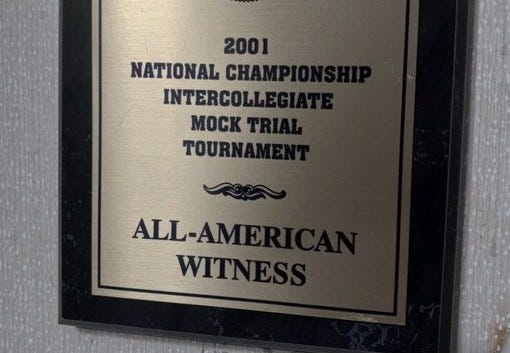
The case of P.J. Gilbertson v Everest Experience is among the most important precedents in the legal history of Midlands, the fictional American state where college students prepare for future law careers with competitive mock trials. I considered law school during my undergraduate career and tried out for the campus mock trials team. We competed in the American Mock Trials Association (AMTA), the NCAA of mock trials.
From the beginning of my involvement, however, lawyering had far less appeal to me than witnessing. I was already indulging a passion for the stage as a theatre minor because playwriting and dramaturgy had seemed like an interesting career choice, too. Happily, I avoided both fates. But between the two interests, there was this moment where I found a strange, sweet spot, and won a few odd trophies.
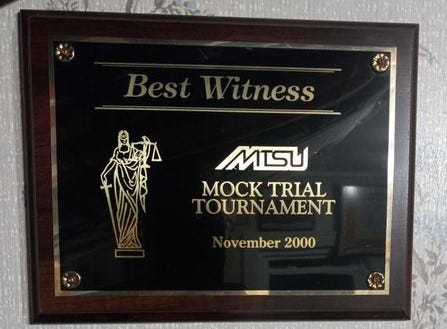
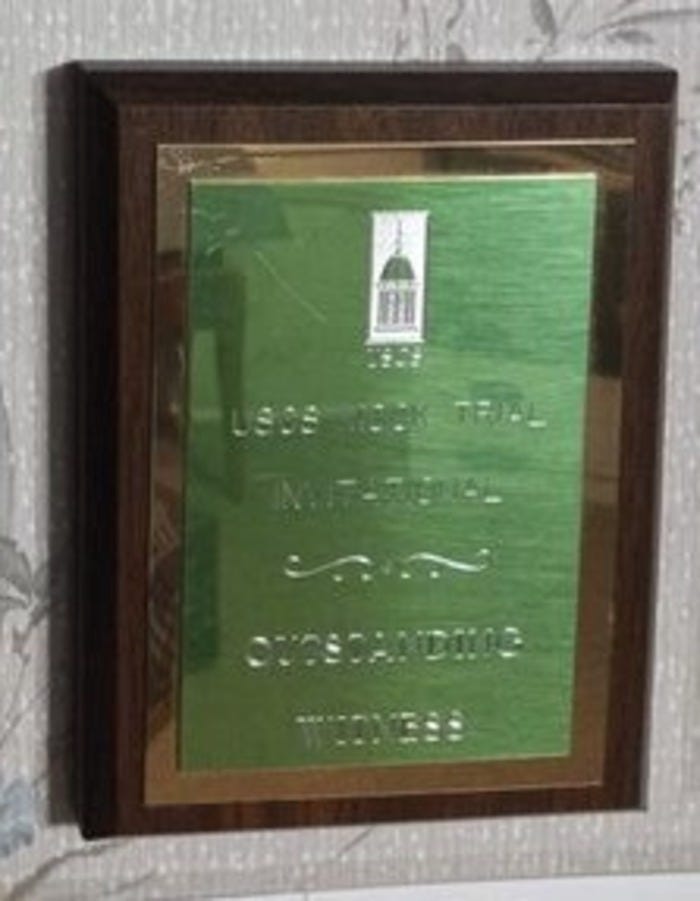
I still have three of them on a wall in my model shop. They are ephemera from my life that will be tossed in a landfill when I die, along with probably everything else that is mine. Which is fine, since they only really mean anything to me, anyway. Here is what they mean.
Like all college mock trial cases, P.J. Gilbertson v Everest Experience uses ‘gender neutral’ names and pronouns for the ‘characters’ who may appear because both male and female students must be able to perform them all. Each side presents three witnesses from the menu, and there are more than six potential witness roles, so there are always unused ‘parts’ for each ‘performance’ at a mock trial. Every trial is different. Every team tries a different strategy each time they compete. I ‘performed’ as three different people on various mock trial stands.
Both attorneys and witnesses are graded on performance. Witnesses do not have scripts, they have affidavits. Questions from each side will focus on the contents of the affidavit. Answers must conform to the affidavit. Rather than a verdict, each side has a total score. Here is where the students learn the difference between direct examination and leading a witness, how to object and get sustained, how to overcome objections, how and when to have the court declare someone a hostile witness. These are lessons that law schools do not actually teach.
Indeed, one of the most devious strategies we employed as a team was to call the strongest potential witness for the other side, ‘play’ that witness as uncooperative on the stand, and have them declared a hostile witness so that our side could ask leading questions of them.
This all happened a few years after I had my first real courtroom experience. Men rarely win custody of minor children in divorce proceedings today, but it was worse then, especially in Alabama. I was on the witness stand for 90 minutes and I must have held up well because I got to raise my child. Then I had to convince law enforcement in another state to enforce the decree.
After that experience, a mock trial courtroom held no fear for me. I had a certain liberty of mind, a sense of self-confidence, that let me inhabit each role completely and honestly, regardless of which side of the trial I was on. Who cared whether Everest Experience had the facts or the law on their side, as long as I could pound the proverbial table?
It was only proverbial, reader. I did not in fact pound on a table. Few real trials are as dramatic as the legal wrangling portrayed on screen. Real courtrooms manage to be a fascinating combination of dreadful high stakes tension and extreme boredom.
Years after my turn at mock trials, I was on that exact same witness stand from my divorce case. This time I was giving voir dire testimony in a murder trial. The defense attorney for a young man who had been the lookout and driver in a robbery and murder wanted to have me tell the jury about my experience with the trigger-puller, who is now sitting on death row. His client claimed that he was anticipating only a robbery, not a murder. My own confrontation with the killer, which had taken place well before the crime, had demonstrated his habitual impulsive violence to me.
Ultimately the judge, not a jury, decided the sentence for the lookout-getaway driver. He is still waiting for parole, because he made a terrible mistake, but he could at least be a free man someday. Who even knows what difference my testimony made. Despite needing two trials to make the verdict stick, the DA had not needed my testimony against the killer, after all. I had only offered it in case he needed to counter any character witnesses for the killer.
During his cross-examination of me, the district attorney simply asked: “You wrote this affidavit for me, in order to help my office in” the death penalty case, “correct?” To which I answered yes. “And you offered this testimony because you believed that defendant to be a very dangerous person, correct?” To which I answered yes. That was it. I was on the stand for only a few minutes. Which is unsurprising, since my affidavit was only a few paragraphs long.
I knew more than I told. By the time I testified, my knowledge of the killer’s uncharged crimes, such as throwing a pregnant 16 year-old girlfriend down a flight of stairs, had grown considerably. Yet this information would have been hearsay, so I did not include it, as I knew the court would only ever accept my own limited but direct experience, with names and location and approximate date, as evidence.
In AMTA, the estate of P.J. Gilbertson sued Everest Experience over a high-stakes mountain climbing adventure gone wrong. The case was inspired by the Jon Krakaeur book Into Thin Air, the nonfictional story of a disastrous real-life Everest expedition, which was recommended reading for students. Ultimately, amateurism was to blame for tragedy on both the physical mountainside as well as in the fictional case affidavits. You climb Mount Everest, you risk your life. Survival depends on a combination of managed risks and pure luck.
While the case was made up, real lawyers and judges were grading us, so the trophies represent judgments of my performances from working officers of courts. Their comments gave me valuable insight into how courts use testimony. What my limited experience on real and mock witness stands has taught me is the value of the affidavit for appearing in court. Put simply, if you put the truth into a document for the court, then all you have to do when you are in court is tell the truth. Mostly that amounts to just saying “yes” in response to questions, because the truth is already written down, and they are just making sure these are your words. Do you stand by your words?
Writing for other websites about litigious weirdos got me sued by one of them some years ago. A sad little old man in Maryland tried to rope a few new people into his pro se conspiracy theory. That is, he was acting as his own attorney (pro se), engaging in vexatious suits and countersuits with other pro se litigants based on various zany daydreams of persecution, and wanted to enlarge this amateur litigation circle-jerk to encompass other people, including me. To be clear, by this point he was just trying to keep my attention, as I was already quite bored of him.
When the envelopes arrived at my mailing address from his local county court, I returned them “addressee unknown.” I figured, correctly, that he was too cheap to ever hire a real process server. I was a much harder target, too, being ‘off the grid’ in the skip-tracing sense.
It worked. The court dismissed me from the suit. Meanwhile, an excellent friend in California, who recieved the same notices, tried the alternative expedient of copying a successful “motion to dismiss” used in the state of Maryland from the internet, swapping names and dates and facts, and also got dismissed from the case. The man trying to sue us was ‘vexatious’ as a litigant, a bothersome sue-happy kook that courts learn to ignore while cashing their filing fee checks, and we both knew it.
But imagine that our gambits to avoid traveling to Maryland and testifying in court had failed. Imagine that I had been forced to come up with a real response to that ridiculous lawsuit. My written answer would have been detailed, and fully factual, and I would have been able to withstand cross-examination as a result. Not being a lawyer, of course, and not being a pro se idiot, I would have been forced to take on the expense of hiring a lawyer in Maryland, and I would have had to take time helping them draft this defense.
Which would be so hateful to me. That was decisive.
Legal writing is awful. I tried legal reading and writing exercises and my eyes crossed. I decided against law school. Also, neckties. Most judges still require men to wear neckties and I abominate them. The mere prospect of legal writing as a career made me want to hang myself with a necktie. Clearly this profession was not for me.
So I do not pretend to ‘know the courts.’ I know only enough about the court system to know that I hate it, and would hate myself in it. These little trophies are totems of my close brush with that dreadful fate of being a lawyer, and my very sensible decision to carve out a different path in words.
Close Encounters of the Stupid Kind

Recently, I recorded a Twitter/X space about the history of my interest in paranormal experiences as well as the history of my skepticism of those same experiences. My posts this year related to the topic are linked below. At the bottom is the not-kidding Top Secret Secure Compartmentalized Information facility in which I had two close encounters of the…
Well, I just learned some new things about My Most Excellent Friend from Alabama - you were once married and you have a kid.
I did not know this. Always thought you were the "happy, go lucky" bachelor type.
Ah yes, the "sad little old man in Maryland". You speak of none other than one William John Joseph Hoge III, a man who availed himself of California law by getting the Sherrif's Deputies to serve me the necessary papers.
And to the other readers of this: Hi, I'm the Excellent Friend in California he's talking about.
To this day, I still don't know what his strategy was in availing himself of California law. Surely, he must have known that it would open him up to being dragged into a California courtroom whereas I had no ties to Maryland.
Clean hands.
Ah yes, the "alternative expedient of copying a successful “motion to dismiss” used in the state of Maryland from the internet" - did you know that one Hoge's more astute readers (yes, feel free to insert your own joke here) actually sussed out that I had cribbed that motion from the very site I poached it from and posted the link to it on his blog in the comment section?
I mean, there it was - a chance for Hoge to study that motion very carefully and work out a counterpunch, but did Our Zero avail himself of such an opportunity?
Of course he didn't! Hoge is a legal genius! He knows the law - except that he neglected to assert any conspiracy in his filing, which is why you won even though you never showed up in court.
Oh yeah, you weren't dismissed - you were still in the suit.
So, yes, that whole sorry affair was quite educational as I finally got to take the measure of WJJ Hoge's awesome legal-fu...and found it wanting.
Good times!