

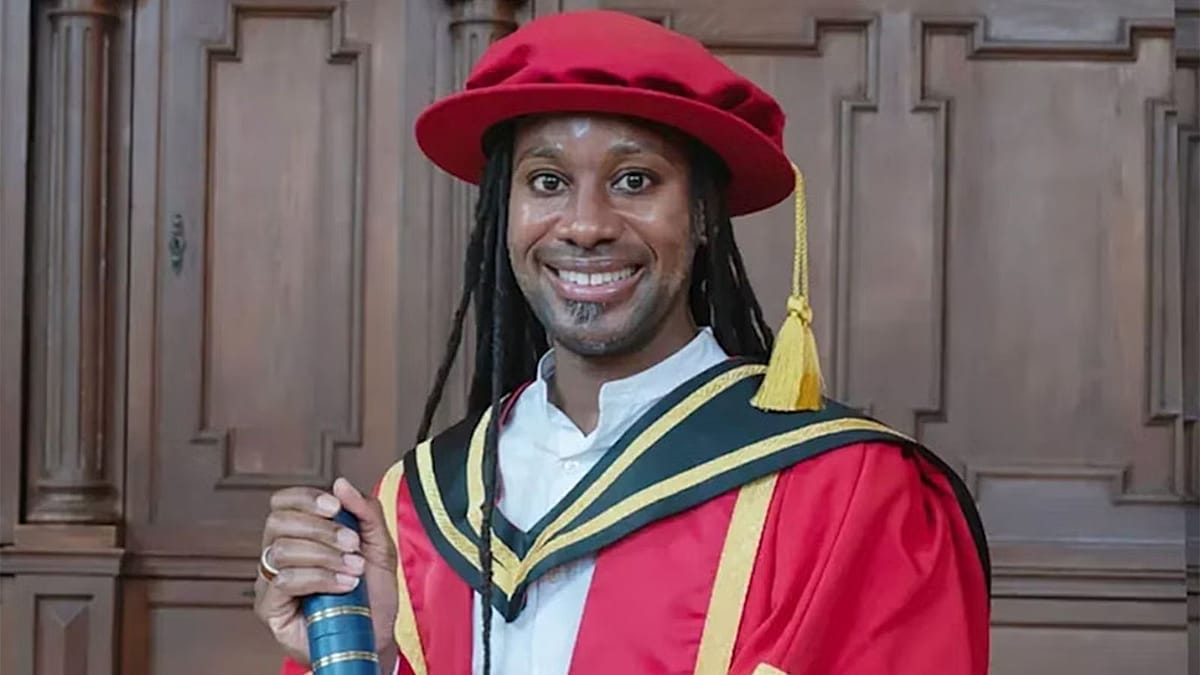
The University of Cambridge has scaled back their institutional review into the death of Jason Arday. His appointment, academic record, and personal history will not be subject to review.
Vice-Chancellor Deborah Prentice had promised a “thorough and transparent” investigation into Arday’s appointment, but instead, former prosecutor Nazir Afzal will investigate his “welfare, his care, his well-being”. Surely someone should have been there?
Not some person. But some corporate entity, surely, ought to have been there? Afzal wants to know what services Cambridge offered Arday before his death on 14 August. A second, broader review of university policies on senior academic hiring, handling of research-misconduct complaints, and support for staff facing intense media spotlights is supposed to follow.
Don’t hold your breath on that one. The terms for the latter inquiry have not been finalized and the changes are already drawing fire. “Some Cambridge professors are now circulating a letter demanding greater institutional accountability and an examination of how the university promoted Arday’s story”.
All accountability is being directed towards the institution, and not in meaningful ways that might create necessary reform. Instead, Cambridge is preparing to hold itself accountable for not doing enough as a university to support Jason Arday. Cambridge is copping a corporate plea.
No individuals will be held accountable. The professors who lifted Arday up too far above and beyond his abilities, then ghosted Arday’s last, plaintive messages at the end, need not fear exposure, for the university administration can take all the blame for not holding his hand, at the end.
Clearly, the only thing left to be done is arrest Cambridge University and put it in prison for this literal murder by suicide. Then everyone can go back to pretending the world’s most prestigious universities have not deteriorated into a morass of race-baiting fraud, blatant cheating, results that never reproduce, and AI slop.
Nikole Hannah-Jones chose bad schools for her daughter, Najya, leaving her child unprepared for high school. Hannah-Jones also wrote the 1619 Project, a popular pseudohistory of American slavery (plot twist: WYPIPO bad!). This remains her greatest achievement as a writer.
Hannah-Jones was so impressed with herself that she thought her mere presence as a parent would improve the school. It did not improve the school. “So you had money to send me to one of the best schools, and you chose not to? Because other kids are disadvantaged, you didn’t want to put me in a great school?” Najya demanded at 16, aware of her actual status as a victim of racism.
Hannah-Jones has since put her daughter into a far more select school, according to her recent op-ed, but still she has learned nothing from her experience. Hannah-Jones clings to the quasi-religious ideology her book represents. Rather than question her priors, Hannah-Jones blames rich white people for holding black children back.
Maud Maron, a white woman who endured professional and personal cancelation after engaging Hannah-Jones in good faith, now looks back on their 2019 interview as an example of what went wrong in American education.
Ms. Hannah-Jones’s question to me, “What are you willing to give up?,” stems from her operating assumption, that white parents are to blame for the bad schools in which too many black children are trapped. “This systemic sorting of worthy and unworthy children is justified by saying that our ‘brightest’ students deserve and demand more rigor,” she writes in her most recent article. “While many of the city’s Asian students have benefited from these screens, in reality the screens are part of a tawdry bargain to keep a dwindling number of white and wealthier parents from exiting the public school system.”
How, then, does Hannah-Jones explain the ‘Mississippi miracle’, in which the state traditionally ranked dead last in education has risen to top ten status in reading metrics among grade schoolers? Mississippi has the highest black population by percentage. White people did not leave. What the state changed was their mode of reading education.
In 2013, Mississippi mandated evidence-based reading instruction with a heavy focus on phonics, phonemic awareness, fluency, vocabulary, and comprehension. Third graders who could not demonstrate reading skills were held back instead of giving them social promotions. Mississippi has shot up in the education rankings of the 50 states ever since.
Despite the abundant and overwhelming evidence that this approach works, university education departments have touted ‘whole language’ and ‘balanced literacy’ models during the same time. Many teachers do not like phonics education, which is repetitive, dry, and uncompelling. It does not facilitate the pedagogy of the oppressed.
Teachers unions have been instrumental in states where the less-scientific models leave children struggling. Teachers encourage students to look at the pictures in a story and guess at the pronunciation and meaning of words instead of practicing them. Students are thus ‘immersed’ in the story, and learn to swim in the sea of words naturally, rather like a child thrown into a pool.
The result is a greater equality of illiteracy, which is Nikole Hannah-Jones’s stated goal. Rather than support the highest achievers, she wants all races to fail equally at reading.
The American university provided the education departments that helped the public schools fail at teaching kids of all races to read more equally. To understand why the western world has lost faith in higher education, just look at what has happened to primary education in the hands of such professional cadres.
A recent assessment by the Progressive Policy Institute found that “the stronger the state’s teachers’ union the worse its student literacy scores were, results which did not exclusively follow party lines but strongly trended that way and often to the detriment of Democrats.” Turns out that bashing teachers has become popular.
Rachel Canter, who pursued the reforms in Mississippi for two decades, says that “Democrats … don’t often ask me how to replicate Mississippi’s success”. Instead, Democrats “ask if it’s possible at all, given the power of teachers’ unions in their home states.” Breaking the teachers’ unions, starting with their power to strike, will be essential to restoring trust in public education as a whole.
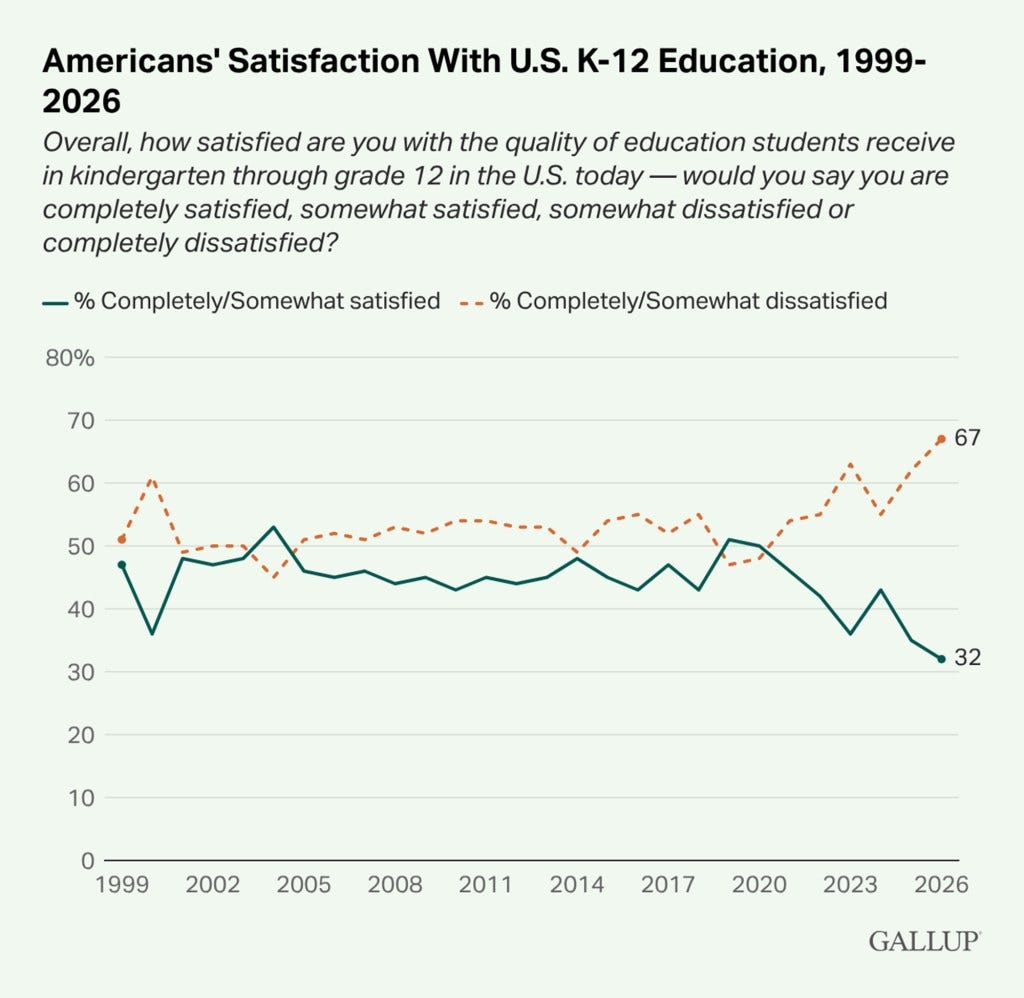
Everyone sees what the university refuses to see. “Universities across the country are slashing admissions to doctoral programs and freezing faculty hiring as they come under financial strain”, Allysia Finley writes in an op-ed The Wall Street Journal.
Turns out that higher education was a kind of Ponzi scheme. Graduate students are the cheap labor in a job market that never grows. They are now as expensive as non-tenured professors were just 20 years ago. Federal student aid is no longer free money, while research funding has reduced.
The resulting “PhD crisis” is a “needed market correction”, per the headline of Finley’s piece. “Increasing numbers of underemployed, overcredentialed and aggrieved young people” are the primary products of the university, these days. In economics, this is called elite overproduction.
Companies had already learned that degrees are meaningless, that half the education was indoctrination, before the Jason Arday controversy. Whatever Cambridge decides to do, the Cambridge degree is already devalued, now. This is generally true of the university in 2026.
In fact, all college degrees have lost value, all across the western world, with the most advanced degrees losing the most value.
The unemployment rate for 25- to 34-year-olds with doctorates (3%) was the highest for any August, with the exception of the pandemic, since the 2009 financial crisis. New Census Bureau data show that median inflation-adjusted earnings for people with Ph.D.s has declined since 2017 by $3,500 for men and $2,400 for women, while median pay increased for high-school and community-college grads.
“Most programs coming under the knife are in the humanities and social-science programs that do more to subtract from the sum of human knowledge than add to it”, Finley argues.
Universities are not holding themselves accountable. The replication crisis, which is endemic to social science and the scientific academy at large, is not being examined, let alone resolved, by the institutions that created it. The 1619 Project is an example of the slop work that that this system elevates. Parents no longer trust the educational elite — with good reason.
Arday plagiarized and fabricated his way to the top at Cambridge, but this will ultimately be swept under the rug, because his academic crimes were far more common than his colleagues wish to admit. Within that system of racial redistribution, in which shoddy work is elevated, Nikole Hannah-Jones is not an outlier, she is a feature product.
Racializing the academy was a mistake. Claudine Gay is paying no real price for her blatant plagiarism. On the contrary, her continued $900,000 annual sinecure as a professor of Arts and Sciences is exactly the sort of ‘support’ that Cambridge will probably decide Arday was due, that other professors should receive, whenever their frauds and thefts are uncovered, as long as they are the right skin color. Poor dears!
The economic incentives of higher education were warped by the self-regard of these institutions. The wider effects of their superstitions on society and politics, indeed on civilization itself, have been injurious and deep. Now that the market is correcting, and the industry collapsing, the academic elite would shift blame to their institutions and escape individual accountability.
No one wants to admit they were the last former friend to ignore a text message from Jason Arday, who was all alone in the world and helpless. No, this was the fault of Cambridge. It was racism, and it can only be fixed with money, and that money must benefit the correct categories of person. The last thing anyone will do is change their minds, or raise their expectations above the level of their soft bigotry.
On The Slow Self-Destruction Of The University

Nobel Prize recipient Dr. James Watson, the discoverer of the DNA double helix, was a genius in the true sense of that word. Still, Watson was destroyed personally and professionally for saying out loud that intelligence has a genetic variability linked to what we call ‘race’. In the western academy, it is a thoughtcrime to notice that genetic variation produces more or less desirable traits in human beings, or that evolutionary time in different environments will produce a variety of traits.