

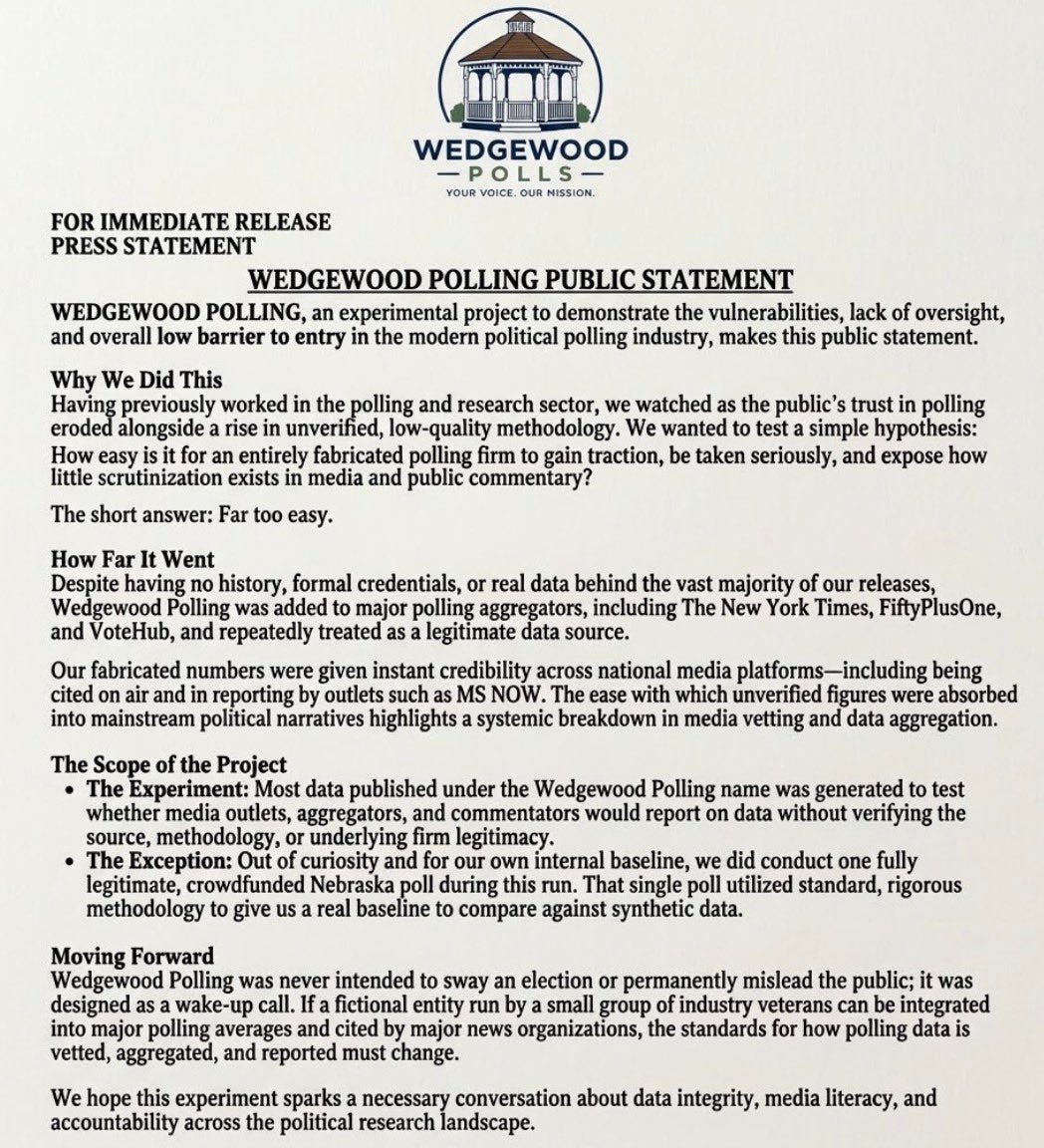
Wedgewood Polls admitted to fabricating months of polling data yesterday after G. Elliot Morris of FiftyPlusOne reached out for comment on problems they had identified in the firm’s data reporting. Wedgewood crowdfunded for polling they represented as legitimate. However, it appears that the scheme may have aimed at profiting on prediction markets.
On X, Morris has released a screenshot of messages “with a person on these servers where the Wedgewood team coordinated their polls” suggesting that one of the people behind the entity “made $4753” betting against Francesca Hong of Wisconsin, who led in their primary polls but lost to David Crowley, an ally of the governor. The allegation will undoubtedly fuel calls to ban Polymarket-style betting on political races.
You can read FiftyPlusOne’s investigation into Wedgewood at this link. My takeaway is that the fabrication was brazen and obvious to anyone who cared to look into their numbers. The problem is that so many outlets did not. “In all the Times’s poll tracker included 15 polls released by Wedgewood between June and October, some of which included multiple races”, reads a statement from The New York Times.
While they stress that Wedgewood did not affect President Trump’s approval rating or generic congressional ballots, the polling averages of some races were clearly inflated. This would have been most pronounced in the primaries — for example, in Michigan, where the Democratic Party ended up with the weakest general election candidate of three choices. “We need to know who was behind this poll, who was getting paid, and what the mission was overall”, Amy Siskind wrote on X.


Wedgewood is in fact the third ‘fly by night’ polling concern in this cycle to publish completely false information. During August, Median Strategies withdrew their data, took down their website, and ceased operations after journalists from the Los Angles Times reached out to them. An investigation by the Guardian revealed that a 21-year old named Rahil Prakash ran the site. Like Wedgewood, they had released fake polls showing a huge lead for Francesca Hong. They also claimed their website had been a “social experiment”.
One week later, FiftyPlusOne announced a permanent ban on all data from The Public Sentiment Institute's (TPSI). They had not only allegedly falsified vote-choice data, but also failed to disclose funding from Florida gubernatorial candidate James Fishback. TPSI acknowledged their “disclosure failure”, but denied any fabrication, calling the discrepancies a “methodological error”.
As I keep saying, I don’t have a crystal ball and I cannot tell you what the final vote tally will be on election night. However, I can see that the polling industry has been breaking for a long time, and it is more broken now than it has ever been. Early voting results do not herald a massive, nationwide blue wave. Democrats have relied too much, for too long, on bad information, and now November will be a margin call on some number of overvalued candidates.
If The Polls Are Off By More Than 3 Points, The Republicans Will Still Control Congress

Overall, the conversation at CNN is pretty much what you would expect, right now. Democrats are leading generic ballots and state polls according to the same polling firms that were off by 3 points or more in multiple previous election cycles. On that note, Chief Data Analyst Harry Enten made sure to give viewers an important caveat this week.