

Originally published in 2023 at The Distance.
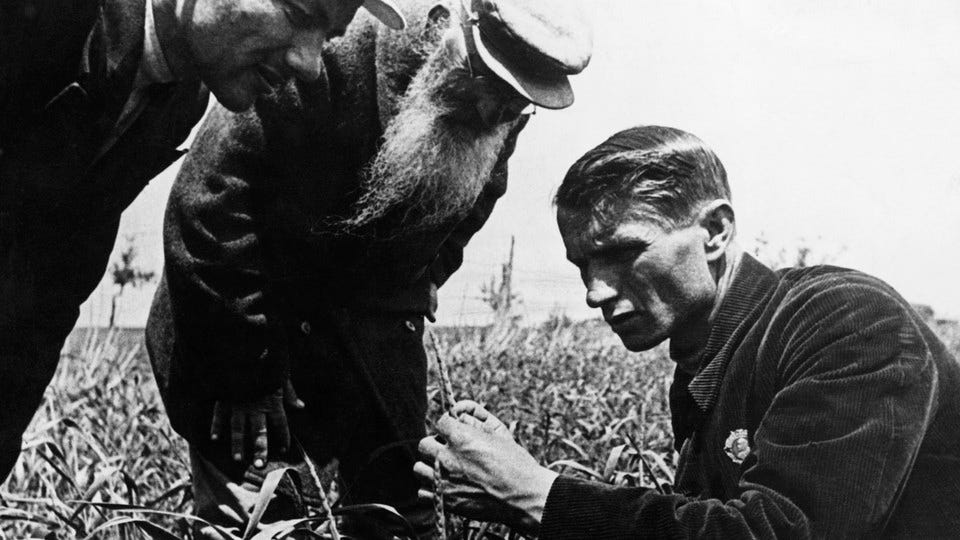
Image curation was a major concern for the Soviets. Despite a vast censorship bureaucracy, however, truths still got out of the Soviet Union in the form of official photography. Truth could then appear as informed commentary on the official caption. When Robert C. Cook published the above photo in a 1949 issue of The Journal of Heredity devoted to “the genetics controversy” in the USSR, he included a tongue-in-cheek comment. “It is noteworthy that Lysenko, who has interdicted experimental controls and the use of mathematics in biological research, needs only eye-power and general impressions to ‘measure the growth of wheat,’” Cook explained. “The presence of that capitalist symbol, Santa Claus, in the center of the picture is purely coincidental.”
Contrary to popular framing, Trofim Denisovich Lysenko did not personally starve millions of people to death, nor was he personally responsible for Stalin’s purges, which included people in his own orbit. Rather, Lysenko’s impact on Soviet and Maoist agriculture was indirect. An applicable modern term might be ‘vaporware,’ for what Lysenko actually did was perform magic tricks and pretend they were science while the actual science languished; it was the Elizabeth Holmes Theranos act writ large. Joseph Stalin found value in Lysenko’s theories and ordered everyone to follow his instructions. Famines resulted from the sham pseudoscience crowding out the real, data-driven science that would have otherwise developed in Russia, much like an invasive weed taking over a fallow field. It simply failed to prevent or ameliorate famine the way real science would. Imagine that Ibram X. Kendi’s ‘Center for Antiracist Research,’ which imploded recently amid accusations of self-dealing and dysfunction, had been put in charge of the US Department of Agriculture. (Arguably, Kendi’s proposed ‘Department of Anti-racism’ would accomplish this exact goal.) Just imagine.
Reading about Lysenko today reveals clear parallels with our new moment of ideological institutional capture by ‘gender identity,’ social justice woo, and postmodern critical theory. “Scientific papers came to require extensive digressions on the significance of the topic at hand in terms of Marxism-Leninism,” William Dejong-Lambert wrote in The Cold War Politics of Genetic Research: An Introduction to the Lysenko Affair, published in 2012. “Scientists no longer criticized one another, they ‘unmasked’ and ‘exposed’ dangerous ideas.” Irascible, “Lysenko remained willfully ignorant of research outside of the Soviet Union, hated math and never passed a formal scientific examination.” In the context of Stalin’s Soviet state, though, “Lysenko’s ignorance and intolerance of dissent were assets.” When everything is political, leaving no room for anything but politics, ‘science’ is shaped by power, not evidence. It is possible to have no scientific background or education, say unscientific things such as ‘the science is settled’, and still have a serious image as a scientist — as long as you have the power to enforce respect.
Lysenko’s power derived from his image as a ‘barefoot scientist,’ a part of the ‘peasant intelligentsia,’ but this image was not original to him. It was a familiar trope from Imperial Russia associated with Ivan Michurin, who was also uneducated and folksy and made the most of his outsider status. One approving colleague described Michurin as “so intimate with plants and has studied their life so much that one glance is enough, and he can already predict the qualities of a plant and its future fruit.” Measurements and record-keeping were elitist bougeois gatekeeping. Likewise, Lysenko judged results by eye alone. A contemporary report described him as an “extremely egotistical person, deeming himself to be the new Messiah of biological research.” He never published in the science press. His ‘theories’ were all based on unique examples, just like Michurin.
Lysenko’s conclusions derived from what would be called ‘lived experience’ or ‘other ways of knowing’ these days. “Michurin’s view was that plantsmanship was an art, incommunicable in abstractions or formulas,” Simon Ings writes in Stalin and the Scientists: A History of Triumph and Tragedy 1905-1953. Michurin produced dubious ‘hybrid plants’ through ‘vegetative blending’ and ‘mentoring.’ Some of the more impossible ones, such as a supposed cross between a melon and squash, “attracted especially negative attention” from horticulturists. His unlikely methods meant “there was no regularity in hereditary phenomena, and no coherent science to be had from studying them.” Michurin was making it up as he went along.
Opposition only hardened Michurin’s belief in his own theories. “When scientists conducted rigorous examinations of ‘mentors’ in Michurin’s nursery, their findings were angrily rebuked,” Dejong-Lambert writes. An impoverished aristocrat himself, “Michurin fumed that their performance was ‘slipshod’ and accused them of ‘undermining faith’ in what he had done.” Russia was newly-atheist, but still haunted by the ghosts of the old religion. Michurin was a guru demanding belief without evidence. His ‘scientific philosophy’ was in fact human moralism projected on plants, so the last thing he wanted was actual data.
Anthropomorphism formed the basis for Michurin’s understanding of the natural world, and he believed all living things were endowed with an intelligent ability to adapt in the struggle for existence. This infinite plasticity implied to Michurin a challenge not to wait on the kindness of nature, but to create new varieties even nature itself could not imagine. He dismissed scientists and academics who sought to understand problems to be answered by Mendel’s statistics, calling them “caste priests of jabberology.”
Michurin did not care for Lysenko. When he died in 1935, however, Michurin’s populist legend became “a bitter myth Lysenko would latch onto,” Dejong-Lambert writes. Lysenko owed no one, for he had grown from the earth itself. When a westerner encountered Lysenko in a cafeteria in 1968, years after his star had set, he was keen to reject any debt to anyone. Asked about Nikolai Vavilov, his former champion in the scientific academy who had died in prison, Lysenko insisted that he was a self-made man.
You think I am a part of the Soviet oppressive system. But I have always been an outsider. I came from a simple peasant family, and in my professional development I soon encountered the prejudices of the upper classes. Vavilov came from a wealthy family and knew many foreign languages. When I was a boy I worked barefoot in the fields and I never had the advantage of a proper education. Most of the prominent geneticists of the 1920s were like Vavilov. They did not want to make room for a simple peasant like me. I had to fight to be recognized. My knowledge came from working in the fields. Their knowledge came from books, and was often mistaken. And, once again, I am now an outsider. Why do you think I was sitting alone here at this table when you came up? No one will sit with me. All the other scientists have ostracized me. I sympathize with the Jewish refuseniks. They are scientists who have been ostracized by the Soviet establishment because they applied to emigrate to Israel, were turned down by the Soviet authorities, and now they have no jobs and no place to turn. They are alone like me.
