How Gavin Newsom Declared Victory In His 'Marshall Plan' For Homelessness
By making the problem move around more

Gavin Newsom had a problem. The governor of California wanted to run for president in 2028, and hoped that the summer Olympics would showcase his leadership when the world came to visit, but the cities were still blighted, despite all his spending.
Newsom had announced a $37 billion “Marshall Plan” to end homelessness in California in 2019, and by 2024 he had spent an estimated $24 billion, but the problem was worse than ever. Programs to build “affordable housing” ended up costing $1 million per resident. California taxpayers had spent almost $250,000 per homeless Californian.
Questions were being asked, but answers were not forthcoming. In 2024, Gov. Gavin Newsom vetoed bipartisan legislation to audit state spending on programs for the homeless. The state auditor said three of the five state-funded homeless programs could not be reviewed “because the State has not collected sufficient data on the programs’ outcomes.”
A federal audit that year gave its lowest possible score to the Department of Housing and Community Development, which oversees the state’s homeless programs. In March, the Legislative Analyst’s Office (LAO) found that “no data have been provided to the Legislature on how many people living in an encampment have received permanent housing (or any other type of housing).”
Lucky for Newsom, progressive policy advocates lost a 2024 Supreme Court ruling, City of Grants Pass v Johnson, which found that localities are able to remove people from encampments without an available shelter bed. Put simply, the Court ruled that the government is not obliged to give a homeless person somewhere to go. Newsom had filed an amicus brief supporting that outcome.
Thus empowered, Gov. Newsom called on cities across the state to ban public camping “without delay” in May 2025. Newsom asked everyone to give homeless campers 48 hours notice of eviction, however, essentially creating a three-day limit for for every person setting up a temporary shelter in the street.
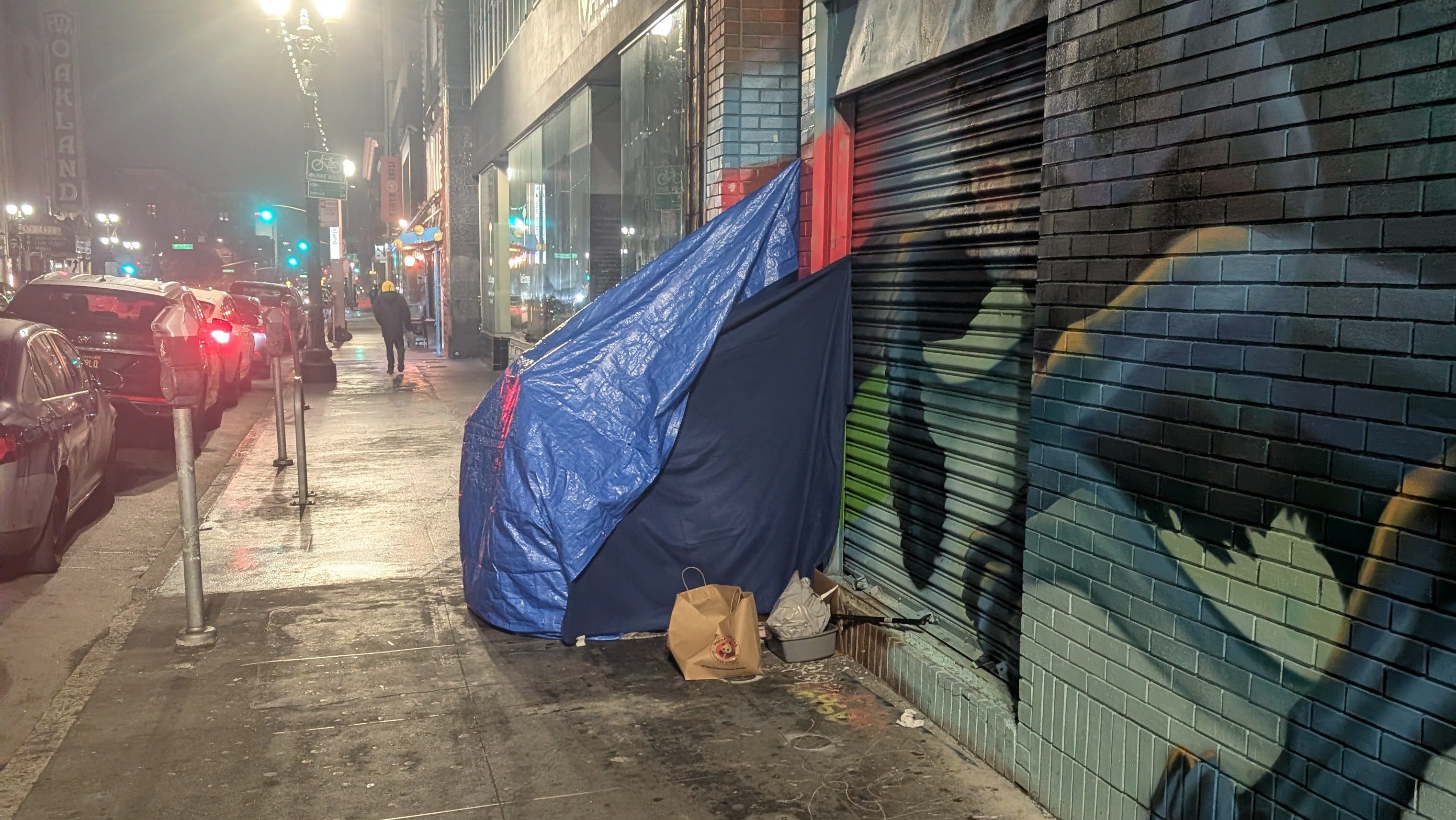
Three months later, Newsom announced a new task force to address homeless encampments “on state property, such as along highway medians or on and off ramps, and under overpasses.” Again, the effective three-day limit simply caused each camper to move on after 48 hours. Rather than end homelessness, Newsom’s clever plan was to make the homeless individual move around more.
Now Gov. Newsom is claiming victory at last. “We are seeing real progress, and we are investing in what we know works”, he said last Friday. Newsom touts numbers showing that homelessness is down 9 percent and wants to celebrate by spending another $419 million right away. Newsom credits much of this success to connecting the displaced with shelter and services, namely rehabilitation. There are three points to consider here.
First, “San Francisco, Alameda County and some other jurisdictions were not included in the 2025 jurisdiction-level data because they conduct their counts on even-numbered years”, according to the San Francisco Chronicle. Having been around the Bay Area a lot in the last year, I can tell you the number of homeless people has not declined, nor have most of the larger encampments been cleared, except directly under the highway.
The lines at the pantry and the soup kitchen and the services building have not gotten shorter. Some cleanup has taken place under the overpasses, but the amount of strewn trash and abandoned clothing has not diminished.
Walk through Koreatown any time, day or night, and you will encounter a man sleeping off whatever drug coma he is having, as often as not while lying across the sidewalk. Women seek cover to sleep. I have spotted them on the concrete stoops of the low income apartments they may hope to live in one day.
May hope, because there are always some people who simply shrink away from any relationship to rules and responsibility. Some of them are restless spirits, most are mentally ill, the largest number are addicted to something, if not more than one thing. Addicts make the worst tenants. Nobody wants to house them.

Progressive ‘harm reduction’ advocates imposed a contrarian policy, especially in the Bay Area, that made many rehab centers difficult places to get clean, since so many people in them were still using drugs. During 2025, San Francisco opened its first drug-free rehab center in the current century. Predictably, nonprofit directors expressed their deep concern that requiring people to be drug-free in drug rehab violates a “fundamental right to shelter” that they made up just now.
This has been a pattern for homeless ‘advocacy’ in California. Newsom’s plan to prod the homeless out from under the highways and into the shelters also drew criticism from the same progressive policy types. Rather than a defeat for the left, however, this was simply a reallocation of the available population to a different set of nonprofits.
Placed indoors, the homeless are easier to count than homeless people outside the shelter, on the street. As noted above, many homeless do not camp in public, preferring hidden places that volunteer survey teams can easily miss. A 2025 RAND study found that Los Angeles is almost certainly undercounting the unsheltered homeless, though to what degree is debatable.
California has 44 Continuums of Care (CoCs), regional coalitions of nonprofits, governments, and service providers that handle these population surveys, but most of them only do a count every other year, on a particular day of the year, to produce a ‘snapshot’ of information. San Francisco and Oakland are among fourteen CoCs that simply duplicated 2024 data to report their 2025 numbers.
But I do not really suspect Gov. Newsom of a conspiracy to undercount the homeless. Instead, I sense two trends that account for the drop better than any policy ever could, because they directly impact the economics of the homeless person.
One is that fewer people carry cash anymore, so that homeless begging and panhandling pays out less than it used to. At least once a day, usually two or three times, I use this same response myself — “I don’t have any cash” — to disappoint a request for a handout. Like the penny, which is being taken out of circulation, the homeless are victims of the debit card revolution.
A decade of policy also made California the most attractive state in the union to be homeless, giving the Golden State twice the average ratio of homeless population. Homelessness became such a problem that even the most generous soul has gotten frustrated, fed up, and limited their empathy.
Hardworking people resent paying rent to live in the same building with someone who has no job and a taxpayer-provided apartment so they can hang out across the street begging for change.
Put simply, the homeless are less welcome than they used to be. Wallets and hearts have shut. If the homeless are actually leaving California, it is to migrate somewhere that people are less frustrated with them, and more generous to them. Most of the unsheltered homeless are just retreating into the shadows, moving around more to avoid trouble, and being counted less.
Gavin Newsom is claiming a 9 percent reduction in homelessness in 2025, bringing levels back to only twice what they were when he began his “Marshall Plan”. At this rate, in 2028, homelessness might even seem to be reduced by one-third from the high that Newsom’s leadership was able to achieve for California. No doubt he will make it seem like the greatest policy victory of all time.


