

Magic City's magic getting stronger
Dynamite Hill ain't on fire any longer
No man should ever have to feel
He don't belong in Birmingham“Birmingham” by The Drive-By Truckers
We finally pulled over at a Buc-ee’s just short of Talladega to see what all the fuss was about. It was the monkey’s end of a three-day cross-country drive so we were feeling more than a little bit silly.
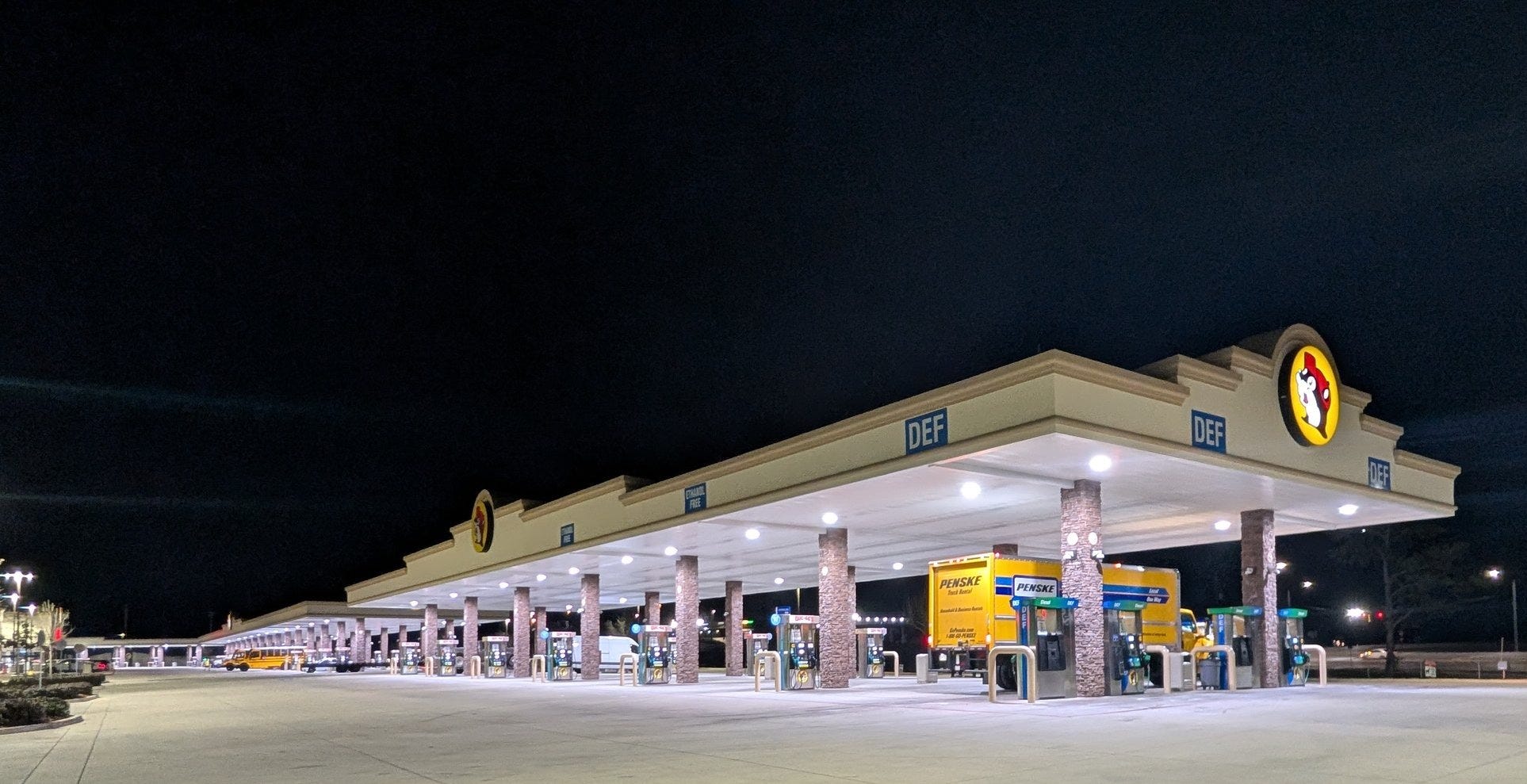
“Wow,” we said at the three huge islands of gas pumps. Enough to beach a fleet. “Hey,” we said with a nod at the charging stations. “Pull into the one at the end,” we agreed, adding: “bring it around to face the exit,” ready for relaunch.
Night was a black canvas, so bright was the lighting. Birmingham was not close enough to make the stars disappear so completely. Prioritizing our biology, we elected to go inside first and fuel the rocket later.
Despite the hour, most of the gas pumps were in use along with two of the charging stations. There were three buses. The store looked busy. We counted a dozen cars and trucks along the storefront, which had three entrances, one at either end and one in the middle. This time of night, the only open entrance faced the pumps.
“Anthropology and archaeology,” we agreed, beginning another game of observation. Inside jokes are after all the bedrock of our enduring friendship.
As we approached the double sliding glass doors, we noted a number of full-size grills and firepits for sale. “Fire,” we noted, suggesting primitive cultural and social activities which hinted at an organized complexity of ethnographic interest.
We confirmed the preparation of meat when we sampled the brisket sandwiches. They were plentiful. We had indeed found a grand ritual feasting site, evidence of possible chieftainism.
Our discovery of an NFL team hoodie on a sale rack was tantalizing evidence that we were on the money. We posed for selfies, for science.
No one was paying us to visit a Buc-ee’s. Indeed, Buc-ee’s had put loads of cash into advertising their existence to us all the way from California. We were simply responding to their enticements at last.
Don was leaving the Golden State for good. He was tired of firesmoke, tired of politics, tired of inflationary regulations. “I can’t believe how much cheaper” everything is, he said, especially gas.
He kept repeating that phrasing all the way across the United States and now he was saying it at a Buc-ee’s in Alabama. Our pit stops had been game sessions, too, and now we just happened to be doing one at a Buc-ee’s in Alabama.
We were on our way to Atlanta, where Don was putting down new roots with a new job.
A new game, taken up on this trip, one of our many shared road trips, was the city song. As we approached a new city, we looked up songs about it and chose ones we had never listened to.
Don had liked the theme of economic and politicosociocultural dislocation in the track we had selected on our way out of Birmingham. He was amused by the name of the band. It all seemed appropriate to his feelings about leaving the left coast in the mirror.
Now he marveled at a highway tourist trap where the prices were cheaper than stores in the city he had left behind.
“I like Alabama,” he declared.
As we entered, a company of female soldiers, likely trainees at nearby Fort McClellan we supposed, were just beginning to check out from the enormous store. Judging that it would take time for us to receive any attention from the store staff, we elected to take advantage of the opportunity, and split up after visiting the necessary.
(“The necessary” is one of those amusing anachronisms of speech that we have adopted into our shared language over the years. Excretory functions have always been funny. Fart jokes are a million years old. A dry, deadpan academic discourse in such an environment can elicit laughter from strangers. They remember the encounter, and being memorable — if anonymous — is the point of the game.)
Having circled the store and surveyed its contents, we reconvened almost twenty minutes later at the beef jerky bar to compare notes.
We agreed on the significance of the long shelf of charcoal, matched by the firewood outside and up front inside the store, along with the various accoutrements of cooking outdoors: lighter fluid, fire starters, tools and utensils, specialized ritual garments such as aprons and gloves with the American flag on them, etc.
We agreed the coffee bar was pretty incredible. Also, it was clear evidence of long-distance trade networks that held immense value to the local community, not to mention travelers in this caravanserai.
Though the location was some distance from the nearest city, it was clearly part of the same state, and an important center of its commerce. A ritual and commercial oasis on the way to another city-state, namely Atlanta-Georgia.
We had already identified a nearby military site, confirming the presence of a highly advanced civilization.
Only a real society could supply such an abundance of beers and sodas and snacks. Forms of social organization must surely be present if there were so many brisket sandwiches, and so many people eating them.
We agreed that we felt we had almost unlocked the mystery of Buc-ee’s on I-20 in Alabama. There was just one more thing we needed to confirm before we could publish our findings.
It was our constant interchange of ideas this way, aloud, though at reasonable volume and dispassionate tone, that made the game funny. To us. I cannot stress enough that we only ever play this game because it is fun for us.
Waiting behind the last of the US Army training company we had encountered, this discussion did not provoke anyone to laugh out loud. It did draw stares and smiles from some, including an amused dad wrangling three kids, all under eight years old.
With a dozen soldiers remaining in the middle queue, we waited in the left-hand line that the staff had opened for civilians. We speculated on the potential special relationship between Buc-ee’s to another local site of interest.
Our hypotheses were interspersed with observations about the selection and quality of goods. Egad, these flavored pecans were delicious. The nuts grew in this region, while the many choices of flavor represented a range of highly-refined palates and a wide assortment of cultural contacts.
A bricolage of beliefs was evident throughout our experience: freedom, the open road, technocratic consumerized choice optimization, scientific hygiene.
We liked Buc-ee’s, we agreed.
We wondered about its relationship to a mysterious ritual site located not far away. As seen from above by the gods, it was a rounded, three-sided shape laid out on the ground.
This vast complex could host an entire kurultai of nomadic pastoralists at one time to observe a ritual competition of heroes. Their dangerous game involved a high-speed race on great, roaring metal beasts.
Excitement would peak whenever the metal beasts touched one another, or touched the wall of the ritual racing track. Sometimes, heroes died. We named the example of Saint Dale of Earnhardt, the elder, peace be upon him.
It was this joke which finally broke the silence. The woman ahead of us, heretofore listening silently, cackled. It was the crack in the dam.
“It reminds me of the Hippodrome,” Don said. I agreed it was like Ben-Hur, a high-risk bloodsport sacrifice to the gods. We compared it to similar pratices on similar planets, such as the rubber rocket races that the Slutherions hold around G4059-A.
We shuddered to recall the carnage. “Think pod races,” we said. “But with extra splatter.”
We agreed that the word “ritual” was quite overused in archeology, but that it definitely applied to the “Talladega Triangle.”
“Don’t get lost in the Talladega Triangle,” I told the gentleman behind us. “It’s rumored to be an interdimensional portal.”
“That’s how we got here from Albuquerque. That left turn is so easy to miss.”
Now we had them all laughing, all twelve strangers left in the enormous store within hearing distance of us. Our comic timing was perfect. The crowd belonged to us.
Purchasing our items at last, we inquired of the cashier, receiving instant validation of our thesis.
“Oh yeah, we’re always packed on race day,” he replied to us in his delicious hyperlocal dialect: Aw yih, we awways pack’t own raceday. We savored this delightful delivery in the truck, later. What a treat.
A primary source. An oral tradition! Yes, this “Buc-ee’s” existed to worship the American road, to share a culture of interstate magic, sustaining belief in the god of freedom.
We locked eyes, nodded, and both sucked at our slushy beverages. Applause. Exeunt.
As we walked out of the store, we agreed to write up our findings in three different ways and submit each version to different journals.
By sheer coincidence, a helicopter was flying towards Anniston at a thousand feet of altitude, shattering the inky night with its probing searchlight, right as we reached the cab doors.
I pumped the gas. Starting the moving van, Don opened the app on his phone and turned up the volume to play “Also sprach Zarathustra.”
I watched the soldiers lining up to get back on the bus and return to their barracks. A Cybertruck had joined the sedans at the Tesla chargers.
After filling the tank, Don and I went through our preflight checklist and then took off again for outer space, to find a strange new world, seeking out new forms of life and civilization, to boldly go where he had never dwelt before.
As we roared towards Atlanta, we talked of decline. NASCAR has suffered since the Wuhan unmentionable. Was Buc-ee’s a sign of regrowth, the budding shoots of the New Kingdom America? We agreed it was worth hoping for. We had a hope in starting over. The actual, real, original American dream.
Beneath the Rings of Rabba on the Curated Worlds

From altitude, the juggat appeared to be a weathered, worn stump. Some ancient tree, a sapling planted at the beginning of time, had stretched to touch the sky, whereupon a god had cut it down, the stump of the slaughtered giant petrifying over eons.