
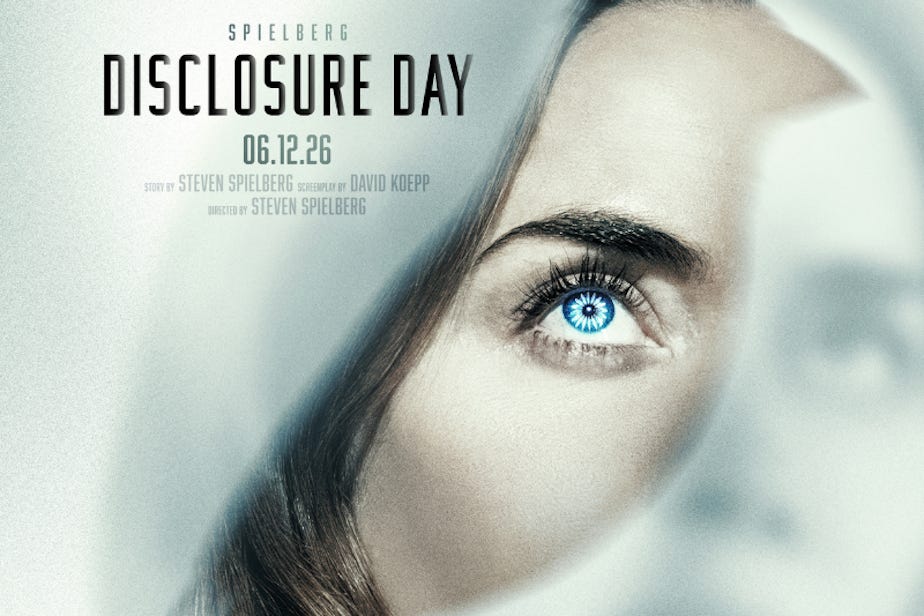
'Disclosure Day' Feels Tired Because Spielberg's Mystery Box Has Always Been Empty
Disappointment, disconfirmation, and the creative cycle of the flying saucer
I am not really spoiling anything by telling you that there is ‘found video’ of alien autopsies in this new film by Steven Spielberg. I am not the only viewer to be struck by how dated the black and white ‘archival clips’ ‘disclosed’ in the film are.
The Roswell ‘footage’ too is unconvincing. Crop circles are no longer dramatic or convincing. The aliens are also unconvincing ‘in the flesh’, and for the same reason: age.
This film consists of too much tired, old stuff. We have seen it all, already. We know the story too well, so that there are not any real surprises.
Spielberg cemented the image of the ‘gray’ extraterrestrial with his 1977 film Close Encounters of the Third Kind. Chris Carter wore it out with The X-Files. Extraterrestrial visitors are a tired franchise. Entertainment consumers are fatigued, now.
David Koepp, the screenwriter working with Spielberg, has too much old, stale, and pale stuff going on, here. Spielberg too is borrowing from his own previous work. Extra credit for cineastes who can spot the callbacks to Jaws, Duel, and Close Encounters.
As I explained last week, Koepp and Spielberg are bricoleurs, while Disclosure Day is a mash-up (bricolage) of the Harmonialist gospel. Spielberg raised the hackles of some religious people by saying the film was supposed to challenge their faith. It was one more misstep from a director at the end of his career.
Harmonialism is an eclectic religious current in American life that seeks to harmonize science and faith through occult means. Emily Blunt using a magic alien universal remote to do magic tricks and telekinesis, or Colin Firth using it for remote viewing and mind control in this movie: this is the Harmonialist story in a nutshell.
The Harmonialist story has inspired science fiction, and taken inspiration in return, since the 19th century. Since 1946, it has taken on the form of a flying object in the sky containing a higher, more evolved intelligence that exists in cosmic harmony with the universe. These objects take on various shapes, the saucer being most familiar and iconic.
But these icons have faded. Disclosure Day aliens have heads the size of E.T. the Extra-Terrestrial, presumably because of their huge brains that give them psychic powers. They are too much of what I have learned to expect, and also not enough of what I hoped to see.
The ‘grays’ are just one trope used in this film that has become passé. Uncanny artifacts that are too old to be in fashion, and not old enough to be back in style, beggar the suspension of disbelief.
I’m tired. Are you tired?
Firth’s character wears all black just to make it stupidly obvious that he is the Man In Black. Spielberg begins with Josh O’Connor in the middle of an encounter with the sinister para-governmental conspiracy to conceal the paranormal truth from us. We have all seen this movie before, this time Spielberg has made it.
As I explained last week, Harmonialism is very good at creating empty ‘magic boxes’. All too often in modern storytelling, writers pile layer after layer of enigmatic questions, secrets, and plot hooks onto the viewer to keep us engaged and theorizing, but then they fail to deliver satisfying, coherent, emotionally resonant, or logical resolutions that satisfy expectations.
Harmonialism does the same thing. The ‘disclosure movement’ is a mystery box plot. Spielberg is using a too-familiar mystery box, and we don’t get to find out what is inside. Expectations go unsatisfied. Spielberg has tried to shake us into awareness. Instead, he may have inadvertently buried the Harmonialist gospel.
The central conceit of the whole Roswell story, the idea that interstellar or interdimensional beings with magic powers and preternatural abilities … crashed their spaceship in the desert … is absurd. The whole story is absurd. In this movie, it even looks absurd.
If the government has kept aliens alive in captivity for decades, what kind of food did they eat? Extraterrestrial biomes are likely not the same as ours. How have they survived this long?
Being from a different planet, produced by a different evolution, has consequences for interplanetary imprisonment. Like the characters in this film, Harmonialists debate among themselves just how much ‘disclosure’ is healthy for humanity. Some technologies are too dangerous for mankind to have.
Then there is the human rights question, because the aliens don’t seem to respect human values. If the government, or some secret shadowy parallel organization, has experimented on these aliens, is it not payback for … whatever it is the aliens are doing to the kids in this movie?
I am left with more questions than answers. This is the essential creative problem in Harmonialist religion. Disclosures never fully satisfy, while stories age quickly rather than becoming timeless.
The mystery box is always empty
The recent disclosed video files of unexplained aerial phenomena, or UAP, are an example of Harmonialist magic boxes containing only disappointments. Spielberg attempts to recreate the ‘found footage’ effect but it all ends up looking like a video game.
Here is Mick West, probably the world’s greatest debunker of UAP imagery, explaining in brief how a balloon can appear to be making impossible movements when it is being observed by a gimbal camera operator. This video was one of the recent files disclosed by Trump’s executive order. It is thoroughly debunked, but it still looks much more convincing than anything in Spielberg’s movie.
Taking in reactions from a number of sources, it is my impression that movie reviewers with the strongest desire for the Harmonialist story about extraterrestrials to be true are the most disappointed in the film. Reviewers with no investment in the tale of Roswell, aliens, and Area 51 are generally more positive, even if they criticize the film.
In other words, Spielberg has made a Harmonialist gospel film that satisfied no one and made everyone mad at him, including the Harmonialists.
Christians are mad about Spielberg’s fumbling challenge to their faith in his marketing interviews. Harmonialists are mad that the altar call in the movie is just one nun reassuring us that everything will be okay because God’s got this. Spielberg’s message is both too specific and too generic.
Spielberg has made an uncanny film. Rather than add mystery, the uncanny valley makes Disclosure Day tired. Diversity casting is supposed to make the story look universal, but instead marks Disclosure Day as a product of its very weird time. Then there is not enough diversity in the fleeting challenge to human religions. Spielberg delivers the worst of both worlds.
John Williams has produced the weakest score of his career, but the movie would still be ten times worse without it. Lens flare does not improve the dark, colorless visuals. Everything about this film feels a little bit wrong in some way. Neither of the two couples in the film have any romantic chemistry.
Some people enjoyed it. They were the ticket-buyers who were least invested in the story.
We got used to disappointment
Meanwhile, running in the background of the entire film, the world is on the precipice of nuclear Armageddon. The ‘stakes’ are not really explained and we do not see what is going on in the world that has everyone on edge.
Of course, the message from the stars is what saves the world from itself. It is a magic box containing the solution for world peace.
This has been the Harmonialist story since December 1952, when George Adamski met a man from Venus in the desert near Mount Palomar observatory. Only a few weeks had passed since the Ivy Mike test of the world’s first H-bomb. The ‘messages’ that Adamski then relayed from his friends on Venus are boring, dime store Theosophy that is supposed to save the world.
Harmonialism is consistently undermined by its own revelatory language. The gravitas of beings with anti-gravity technology is utterly dispelled by a script from a fortune cookie. Spielberg and Koepp have stopped just short of revealing the contents of this mystery box because it would bore the shit out of us.
The film ends with an extraterrestrial message that is passed to Emily Blunt, who then stands before the newsroom camera that is linked to the entire world: we, the human race, are all paused at the threshold of nuclear apocalypse, watching her deliver a message of peace from outer space on our smart phones.
“Listen”, she says, and then the movie ends.
We never receive the message that was hidden in the mystery box, the words that bring heaven to earth and change us forever as a species. Koepp and Spielberg have stopped just short of imagining heaven, descending.
A creator can only present us with a limited slice of heaven in any story because conflict drives plot. The same problem bedevils apocalyptic films like the Left Behind series. As anyone who has read the full Divine Comedy knows, Dante’s hell is entertaining, but his heaven is boring.
If Blunt kept talking, the message would inevitably sound like George Adamski’s “space brothers”. Harmonialist heaven is always boring, and always quaint. Every Harmonialist text I have read has amazing passages that beggar credulity because they are clearly products of a different time than ours. Old attitudes become embarrassing to liberal-minded people of the future.
Every update to the Harmonialist story thus fades with age, so that some new creator must reboot the story from its beginning. Spielberg has tried, and failed, to refresh the familiar story of hidden extraterrestrials and the world-altering promise of disclosure.
Perhaps Steven Spielberg could not hope to make it work because the old story no longer works. ‘Disclosure’ in the real world has also failed to produce the promised evidence. The audience has been trained to expect disappointment. Disclosure Day delivers it.


