

It was not supposed to be this hard. Democrats were counting on voter anger at Donald Trump to give them power in Congress again. Any normal presidency has thermostatic effects on voters, and Trump is hardly a normal president.
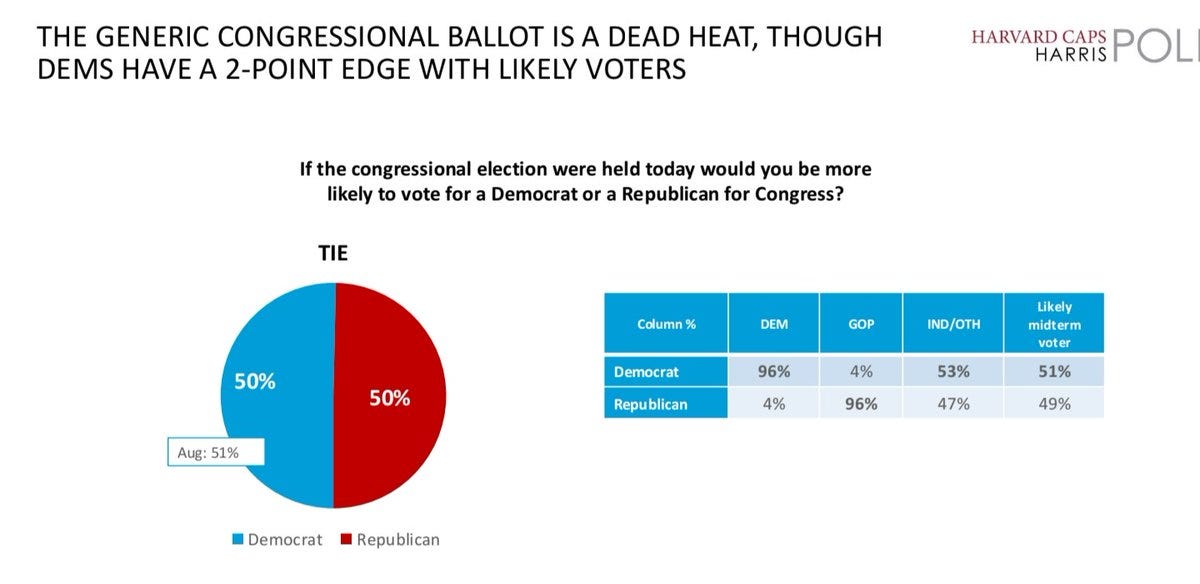
Surely the American voters will reward us for oppositional defiance of Trump, Democrats thought. It was not an unreasonable strategy, but it was bound to wear out on Americans eventually. Perhaps we are already there, because the generic ballot polls are not showing a strong blue wave.
It is not entirely Democrats’ fault. They have relied too much on polling, and the polling industry is increasingly broken all the time, and the media reports polls with the incessant rhythm of a horserace for too long before the election. Democrats could very well be overestimating their position in November, and the echo chamber might have egg on its face again.
Structural bias is one problem for polls. When a legacy media outlet hires a college polling firm, for example, the incentives are all stacked in favor of liberal bias. The political science department and the editors’ room both likely lean left.
The newspaper or news channel will want results that fit the editorial line, while the college polling firm will want to please its customer. These partnerships in fact supply most of the allegedly ‘nonpartisan’ survey results you see in public reporting.
Most of the remaining market in political surveys belongs to partisan, often internal, polling concerns. Campaigns and committees have even more obvious bias than a media organization. While they get less attention than the headline polls that media pays for, these explicitly partisan polling entities produce most of the surveys that get released in any given election cycle.
This tendency of polls to reflect the biases of the human institutions that create them is called the house effect. It shows up as a repeated offset. If any firm has consistent results that favor one political party by, say, 3 points, that is the measure of their house effect. Rasmussen has a house effect, so does Public Policy Polling. A house effect can be stable over time, though of course it is always wrong.
Even correcting for this bias is fraught. Averages only improve if the relative lean of the firm is consistent. When the whole industry shares the same miss, as happened in 2016 and 2020 and 2024, then adjusting one firm’s results towards the others does not fix the consensus error. Silver Bulletin and similar aggregation firms are unable to eliminate the house effect, producing a house effect from a consensus of the houses.
A truly independent political polling firm is uncommon, and the results that the most independent pollsters firms produce get the least attention in any election cycle. Even a standalone commercial firm can exhibit a measurable ‘house effect’ in their results. To date, no one has figured out a way to eliminate the house effect in polling.
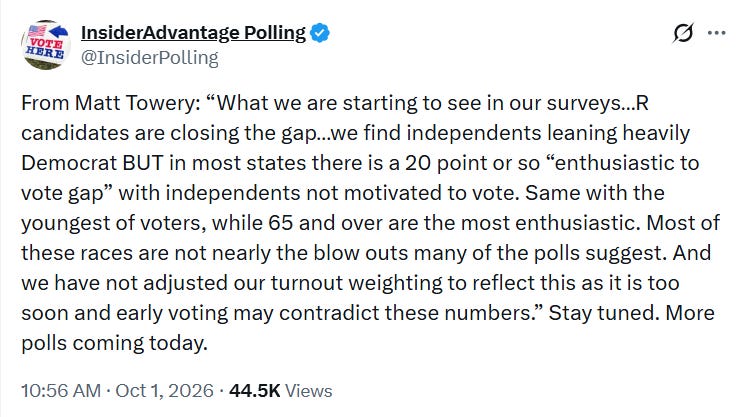
Rasmussen, Trafalgar, InsiderAdvantage, and Big Data Poll formed the National Association of Independent Pollsters in 2025. They do not include media and college surveys in their club.
Their membership is exclusive to firms with a published accuracy record, a category that happens to include well-known conservative firms. This association did one joint national survey the same year. They found the generic ballot basically tied.
This week, Rasmussen says the generic ballot lead for Democrats has shrunk to just 5 percent. It was 8 percent the week before. Big Data Poll also has a crowdfunded generic ballot. Right now, it still shows Democrats with a shrinking double-digit lead.
As the saying goes in elections business, September polls are not October polls. As Harry Enten pointed out on CNN this week, these polls have historically been off by 6 or 8 points in battleground states. Michigan seems to especially defy polling.
Methodology is another layer of failure. All surveys use sampling and then skew their raw results according to the expected voter turnout. Midterms are low-turnout elections, so Democrats are counting on high-intensity anti-Trump turnout to win congressional races. The polls have reinforced their belief it was working, but the polls have problems, and they show the thermostatic effect is cooling.
