

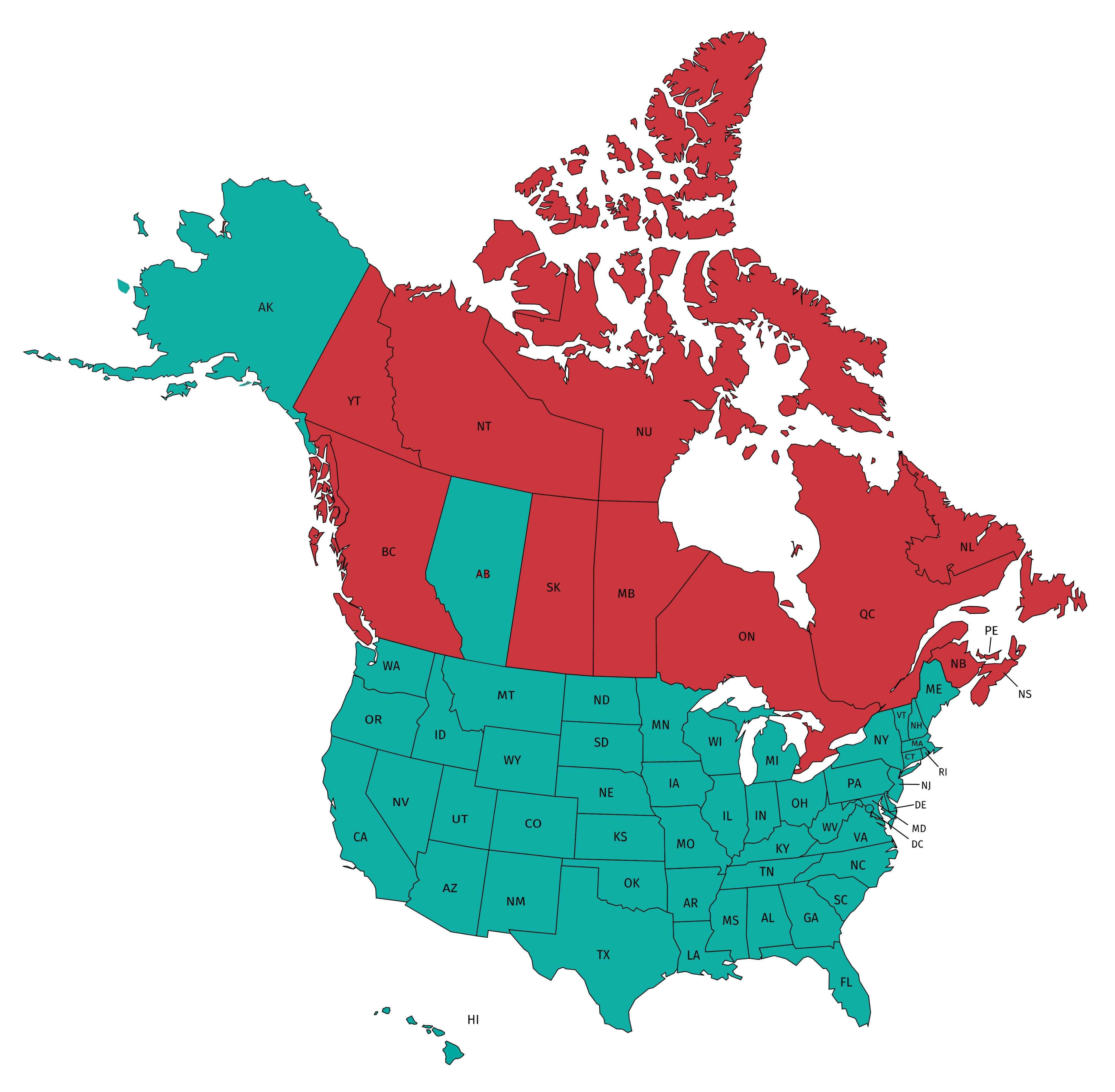
Albertans go to the polls in October to decide Question 10, a referendum on whether to begin the process of thinking about possibly planning to maybe leave Canada, some day. Polls show that the measure is unlikely to pass. However, the other nine questions are probably going to fare well with voters.
Alberta is different from Ontario in the same way that, say, Texas is different from California, but Canadian identity remains at the core of Albertan identity. Albertans want to remain Canadians, but they want to remain different Canadians. Alberta has always been different from the rest of Canada.
Economics describe a cultural difference. Alberta is the only Canadian province with no sales tax. Corporate income taxes are among the lowest in the country. Resource royalties from oil and gas are volatile, but they substitute for other forms of tax. This is the “Alberta Advantage”, and it is why the province routinely posts the highest GDP per capita compared to the rest of Canada.
Local politics reflect the difference. Federal voting has been strongly conservative in Alberta for decades, running counter to the nation as a whole. A long tradition of Western alienation from Ottawa has only grown more intense as national carbon policies and resource regulations have affected Alberta’s oil and gas industries.
Alberta receives nothing from the equalization formula that props up other provincial governments with less revenue. Alberta’s measured fiscal capacity is always the highest in the country, so the province does not qualify for revenue sharing, but it still makes the largest contribution to Canada’s federal budget. Many Albertans resent this arrangement.
All of Canada, including Alberta, is reacting to a wave of immigration from 2022-2024 that created economic shocks. Like their American neighbors, Canadians have changed their minds on immigration questions. Five of the ten questions on the October referendum impact immigration policy in the province.
Danielle Smith is the provincial premier, the Canadian equivalent of an American state governor. Right now, she is taking flack for even putting Question 10 on the ballot. Still, Smith is probably going to win on all the questions that actually matter to her, including the immigration-related questions. She has no interest in Albertan separatism. She just understands Alberta very well.
Alberta’s culture of self-reliance
One measure of the difference between this province and the rest of Canada is that Alberta frequently records the strongest internal migration of Canadian citizens. The population is also younger than most provinces due to this in-migration. While most attention goes to foreign-born immigrants, the movement of Canadians from the east of the country to Alberta in search of jobs has driven most of this population growth most of the time for most of the last 45 years.
Deindustrialization of the Maritime provinces led to high unemployment across eastern Canada during the late 1970s. Meanwhile, Wayne Gretzky made his first start with the Edmonton Oilers in 1979. Alberta was booming right as eastern Canada was dying. Many working class Canadians rejected welfare benefits for staying put, moving west to the new oil patch in search of honest work instead. This trend was soon captured in the lyrics of “The Idiot”, a 1981 song by Stan Rogers from the album Northwest Passage. The title is ironic. Rogers gave voice to a perspective that was politically polarizing even then.
In his 1992 oral-history book Away: Maritimers in Massachusetts, Ontario, and Alberta, oral historian Gary Burrill frames his anthology of internal Canadian migration stories through the lyrics of this song. It is a folk classic because it connects the deep roots of Albertan success to the Protestant work ethic expressed throughout Rogers’s work. Rogers calls on “all you fine young fellows / who’ve been beaten to the ground” to “bid farewell to the Eastern town / You never more will see” and find “self-respect and a steady cheque /In this refinery”.
I remember back six years ago
This western life I chose
And every day the news would say
Some factory’s going to close
Well, I could have stayed to take the dole
But I’m not one of those
I take nothing free, and that makes me
An idiot, I suppose
Stan Rogers died tragically in 1983, so we cannot know what his opinion about current Canadian politics would have been. His vivid lyrics perfectly capture an idea of Alberta in his own time, and moreover they reveal something that Albertans still want to preserve about the character of their province today. Danielle Smith gets it.
Immigration measures on the ballot
“A new poll ahead of Alberta’s fall referendum finds that a majority of voters will likely vote in support of the five questions related to immigration” on 19 October, according to the news from Edmonton. An opinion survey in August “found that 66 per cent of Albertans support the provincial government introducing a law requiring individuals provide proof of citizenship to vote in a provincial election.”
‘Voter ID’ has been a contentious political issue in the United States for decades. In Canada, it has been a contentious topic since 2007, when Harper-era Conservatives made proof of identity and address mandatory at federal polls (Bill C-31). The controversy peaked in 2014 with the Fair Elections Act. Echoing American Democrats, opponents denounced the measure as a solution in search of a problem. Liberals have rolled back some measures of the Act.
The requirement for proof of citizenship in Question 5 of the October referendum is a new layer of controversy. All Canadian elections require ID, but no other province currently requires citizenship documents at the polling station. Naturally, opponents charge that the measure is “scapegoating” all the usual minority groups in “an age-old strategy of blaming minorities for the social, political, and economic challenges facing society”.
Bronwyn Bragg, the report’s author and a geography and environment professor at the University of Lethbridge, says most Albertans are not paying attention to the referendum’s questions about immigration.
“The separatist question is taking up all the oxygen in the room,” she said in an interview, calling it the “most alarming” of the 10 questions.
Bragg is being disingenuous. I found six polls going back to May. An Angus Reid poll in August had the highest support, just 33 percent, for Question 10. None of the other five surveys reached 25 percent support. “Separatism”, which Bragg considers intrinsically anti-immigration, is the least-threatening measure on the ballot in terms of likelihood to actually pass, and does not actually achieve separation even if it was to pass.
All five immigration-related questions on the referendum ballot are likely to pass. Research Co. found that “65 per cent of respondents are in favour of the Government of Alberta taking increased control over immigration for the purpose of decreasing it, prioritizing economic migrations and giving Albertans first priority on employment opportunities.”
Research Co. president Mario Canseco said all five questions on immigration saw a level of support around 60 per cent.
“This is quite remarkable … unless something changes drastically, we’re going to see those pass,” Canseco told CTV News Calgary. “There is definitely a sense that the notion immigration is having a negative impact in the lives of Albertans is resonating with the public.”
He added that a question on Alberta leaving confederation was only supported by 22 per cent of respondents.
According to Smith’s detractors, these questions create “an us versus them divide” in Alberta politics. Immigrant rights lobbyists complain of “hate rhetoric” and “fear”. The Globe and Mail calls it a “shameless attempt to scapegoat immigrants”. Let us be charitable, for the sake of argument, and assume these advocacy voices are right. If so, then Bronwyn Bragg is wrong, because the separatism question is not “alarming” in the least.
Bragg is condescending when she says that Albertans “are not paying attention” to the immigration-related referendum questions. The proposed measures affect eligibility for public welfare programs funded by the province — health care, education, social services, all the many things that every Canadian citizen expects their provincial government to provide.
Anyone with non-permanent immigration status living in Alberta would be charged a fee — basically, a health insurance premium that includes education services. These are commonsense measures to most Albertans.
New residents will also have to live in Alberta for a full year to qualify for any social welfare programs, and it is here that we find the historical character of Alberta reasserting itself. Temporary ‘guest workers’ are deeply unpopular with working class voters across North America and were one cohort of the recent immigration wave that soured Canadians on Liberal Party immigration policy. As the song reflects, ‘the idiots’ in Alberta, the Canadians who made the province great for decades, demand a measure of self-respect from people who come to work there.
“For every $1 of taxes a guest worker generates, taxpayers are covering $10 in services. This is not sustainable”, Danielle Smith has said. Critics dispute her math, but this is a losing response, because it merely slides the scale down to some other dollar figure that will not make Albertans feel better.
Her government’s $4-million promotional campaign asks Albertans to vote yes on questions 1–9, but not 10. Smith says she plans to vote “remain” on the question herself. She has not put any resources into making it pass.
Her cabinet only produced the nine questions that “deal with immigration” and “strengthen our constitutional and fiscal position within a united Canada” (emphasis added). Smith only added Question 10 to the ballot after a judge on the Alberta Court of King’s Bench blocked a citizen referendum on independence for not consulting First Nations beforehand.
Smith says she simply wants the “Stay Free” petitioners behind the earlier initiative to “be heard”. They will of course vote for the rest of the questions, in her coalitional calculation. Letting support for independence onto the ballot in this way is a classic stalking horse strategy.
The elite consensus in Canada that concerns about immigration are an automatic slippery slope to national dissolution is being exposed as a fraud. A moment happened in America in 2024 when opposition to open border immigration policy became speakable, and that is happening in Canada, too. The federal culture of governance is in retreat as the Albertan culture of governance asserts itself.
