

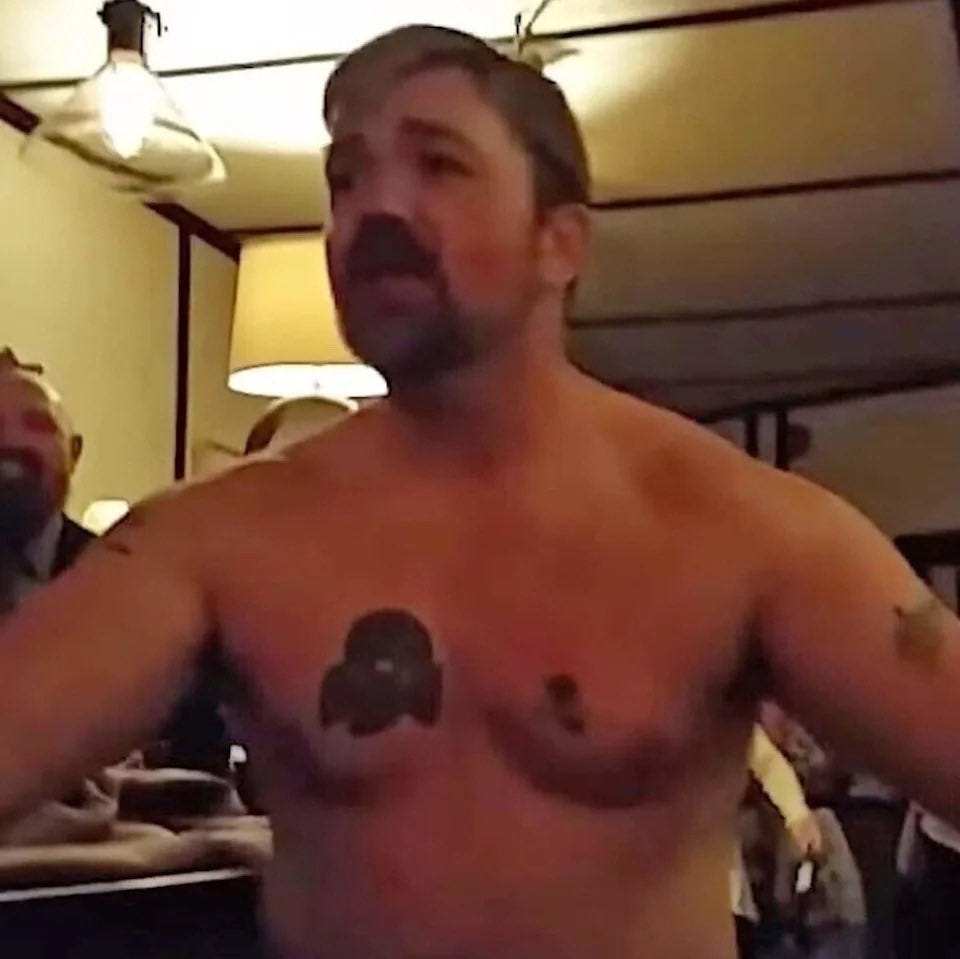
“I am not a secret Nazi”, Graham Platner insists.
Instead, “I got older and became a communist”, he also insists.
I believe him on both counts, and his tattoo is the reason why.
Allow me to explain.
History of a sanguine symbol
Schutzstaffel (SS) death camp guards did not choose the Totenkopf at random. The skull and crossed bones worn by some SS units are copies of the Totenkopf worn by Prussian soldiers since the 18th century and adopted by mercenaries from eastern Europe. It likely has its origins in the Hanseatic League, as it was used to mark deaths in ships’ logs for centuries. A military Totenkopf however has always stood for deathlessness, the undaunted courage of warriors, a deep cultural value entirely outside of civilian understanding.
This does not excuse it.
On the contrary: landbound, the Totenkopf has always been a symbol of bloodlands, an icon of the terror of civilians at the hands of bestial men. Even in 1741, when Franz Baron von der Trenck led his infamous Totenkopf-wearing unit of Pandurs against Frederick the Great, you would not want any wearer of this symbol to sit at your dinner table. You would certainly not invite them to a wedding. The baron’s men were half-outlaws like himself, a mounted border guard from the Kingdom of Slavonia on the verge of the Ottoman Empire who ransacked churches, burned cities, and killed for sport.
Graham Platner did not choose the Totenkopf at random, either. “We went ashore in Split, Croatia”, he has explained, “and we got very inebriated, and we decided to go get a tattoo. And we chose a terrifying looking skull and crossbones off the wall, because we were Marines, and skulls and crossbones are a pretty standard military thing”.
I have doubts. The American armed forces have always regarded the Totenkopf as a problematic symbol, especially since 1995, when a gang of white soldiers at Fort Bragg killed two black residents. Due to the country’s problematic past, Croatia also bans any public display of the Totenkopf, so the tattoo parlor would have been in violation of the law. Professional tattoo artists do not like to work on drunks, either, since alcohol consumed in the 24-48 hours before a tattoo session can cause problems for both the artist and their canvas. So Platner may have selected the tattoo while drunk, but most likely had it applied while he was sober.
Platner has told contradictory stories to Genevieve McDonald, his former campaign manager, about whether he was aware of the symbol’s use by the SS. He definitely displayed consciousness of guilt in the disclosure. According to McDonald, Platner’s campaign was very aware that the story would get traction and “released it themselves to some podcast bros, along with a video of him shirtless and drunk at a wedding to try to get ahead of it.”
“It was not until I started hearing from reporters and D.C. insiders that I realized this tattoo resembled a Nazi symbol,” Platner claimed when the story surfaced. “I absolutely would not have gone through life having this on my chest if I knew that — and to insinuate that I did is disgusting.” Platner is a military history aficionado, so this claim beggars belief.
In comparison, Platner has explained his moral principle on sexual assault this way: “Holy fuck, how about people just take some responsibility for themselves and not get so fucked up they wind up having sex with someone they don’t mean to?” Platner has declared in reference to anti-rape underwear. “So if you don’t want to be in a comprising situation, act like an adult for fuck’s sake.” His own compromising position in the tattoo chair took place when he was a legal adult, but we are supposed to forgive him because he was young.
Democrats are fine with it as long as Platner wins
Democratic Sen. Chris Van Hollen of Maryland excuses Platner’s tattoo because “he went through a really rough period, yeah PTSD type period, and he is himself said there are lots of things he’s done, and said that he completely regrets … I do believe people should have second chances and that people can learn from their mistakes, and I think he’s been doing that.”
This is very interesting, because just three months ago Van Hollen was so very, very concerned that the Grok AI chatbot was supposedly spreading antisemitic and Holocaust denial content at the behest of neo-Nazi accounts that he “demanded answers” from the Department of War about plans to use it. He proudly joined Sens. Adam Schiff of California, Richard Durbin of Illinois, John Hickenlooper of Colorado, and Raphael Warnock of Georgia — all Democrats, naturally — in a group virtue signal over the matter.
Sen. Chris Murphy of Connecticut once claimed that Elon Musk “did a Heil Hitler salute” because he made an awkward gesture. “This may be the most dangerous moment in modern American political history”, Murphy declared. Confronted now by Platner’s tattoo, a symbol famously worn by actual, real, not-imaginary Nazis, Sen. Murphy is more forgiving. “He just seems like a human being who made a mistake. Plus he’s polling really well.”
Apparently, the valence of the symbol changes according to electoral math rather than any sort of consistent moral principle. The only consistency here is that Democrats get to denounce anyone they dislike as a Nazi while simultaneously dodging Nazi symbols on their own candidates. If Democrats lacked double standards, they would have no standards whatsoever.
