

![Mugshots of Lee Harvey Oswald #1] - The Portal to Texas History](https://substackcdn.com/image/fetch/$s_!W4ZN!,f_auto,q_auto:good,fl_progressive:steep/https%3A%2F%2Fsubstack-post-media.s3.amazonaws.com%2Fpublic%2Fimages%2F8f76309b-edfc-4410-8484-677ebc66764a_1500x970.jpeg "Mugshots of Lee Harvey Oswald #1] - The Portal to Texas History")
Yesterday was that anniversary again. Sixty-three years have passed since Lee Harvey Oswald, an ideological communist, killed President John F. Kennedy in Dallas. Two days later, Oswald was shot and killed by Jack Ruby, whose motive remains obscure. This was a happy convenience to the KGB, which seeded fantastical stories in the West about CIA plots, and to the American left, where those stories helped rationalize the assassin as a patsy.
Mark Lane, a self-described “radical who is trying to be a revolutionary”, was the first to develop inconsistencies into a coherent conspiracy theory. Lane first published his work in “Defense Brief for Oswald”, an article in the 19 December 1963 edition of National Guardian, a left-wing independent newsweekly. He developed his conspiracy theory into a 1966 book, Rush to Judgment. In my interview with journalist Gerald Posner earlier this year, he mentioned Lane as a potential defense attorney or advisor to Oswald had he lived.
Lane was a New York City attorney, a Democratic State Assemblyman, and a Reform Democrat. He had managed some aspects of John F. Kennedy’s campaign in the city and ran as the vice-presidential candidate on the Freedom and Peace Party ticket in 1968. Lane was part of the National Lawyers Guild, and like the NLG itself, he was involved with Communist Party front groups.
The first Oswald conspiracy theorist was hardly ideologically neutral. Lane wanted to sow doubt that a committed communist had killed Kennedy because he was a fellow-traveler of ideological communism himself. Lane wove most of the original conspiracy threads that aficionados of the assassination still cite today.
Lane maintained that the package Oswald took to work that day contained mere curtain rods instead of his disassembled Carcano rifle. Reader, when was the last time you took curtain rods to work with you?
If you have ever heard a story that Oswald was the patsy or the fall guy, that he was not even on the 6th floor at the time of the shooting, or that he spoke with Officer Marrion Baker and Roy Truly in the second-floor lunchroom too soon after the shooting, then you know the legacy of Mark Lane.
Despite the ten eyewitnesses who identified Oswald as the man who shot Officer J. D. Tippit, Lane presented inconsistencies in the timeline as well as witness statements to claim that Oswald was not responsible for the shooting at all. Finally, Jack Ruby was sent to silence the patsy, according to Lane.
This remains the basic story of the conspiracy against both Kennedy and Oswald, since both men are supposed to be targets of the same devilish plan. Lane also worked with right wing figures who were amenable to conspiracy theories, seeding the full political landscape.
He was a Jewish anti-Zionist, so Lane made a big fuss over the mere fact that Yitzhak Rabin was in the United States at the time of the assassination. He could not connect Rabin to anything that happened in Dallas, of course, but Lane was eager to speculate. It is probably not a coincidence that the KGB ramped up its anti-Zionism campaign around the same time.
Incredibly, Lane was a lawyer for the People’s Temple and was at Jonestown when Jim Jones told his followers to commit mass suicide. Lane had been hired to pursue claims of a “grand conspiracy” involving the CIA, FBI, and other intelligence agencies against the People’s Temple. Lane escaped the slaughter with fellow attorney Charles Garry. He wrote a book about his experience, The Strongest Poison, published the next year, 1979.
As his final act, Jones held a ritual court with commune resident Christine Miller. “Is it too late for Russia?” She asked, objecting to mass “revolutionary suicide”. Jones, who had tried contacting the Soviet embassy in Guyana about group emigration to the Soviet Union, had already sent gunmen to the airstrip to kill an American Congressman. It was “too late for Russia.”
“You think Russia’s gonna want us with all this stigma? We had some value, but now we don’t have any value.” Communists who assassinate people have no value to the Soviet state. They are not the right kind of defectors.
Thomas G. Buchanan was next out of the gate with an Oswald conspiracy theory, and his ties to ideological communism are not in dispute. He had joined the American Communist Party at the age of 12 and was fired from his job at the Washington Evening Star in 1948 after the newspaper found out about it. Like many western communists, Buchanan disowned the Communist Party after Stalin’s crimes were revealed in 1956.
Moving to Paris, Buchanan resumed his journalism with L’Express, where he first published his arguments in early 1964. His book, Who Killed Kennedy?, was published in May — a six-month turnaround time from assassination to publication. Buchanan argued that Oswald was a mere accomplice who had let a gunman into the Texas School Book Depository, but did not shoot Kennedy himself.
Buchanan also suggested that a second shooter had been positioned on the railway overpass at Dealey Plaza. It was the beginning of the endless search for additional snipers that culminated in the ridiculous 1988 documentary The Men Who Killed Kennedy, which purported to discover “Badge Man” and “Black Dog Man” hiding in foliage behind the fence in grainy photographs of the scene. Obviously, tying even one more person to the assassination was always the object of these efforts, and all of them sought to clear Oswald of responsibility.
Who Killed Kennedy? is “filled with all types of false statements”, Posner observed in our podcast interview. Buchanan framed the assassination as a right-wing conspiracy, proposing a scheme that involved Texas oil interests as well as a Black Lodge of sinister warmongers from the military-industrial complex. Put simply, Buchanan held capitalism responsible for the assassination of John F. Kennedy, and this fully explains all his efforts to clear Oswald’s name.
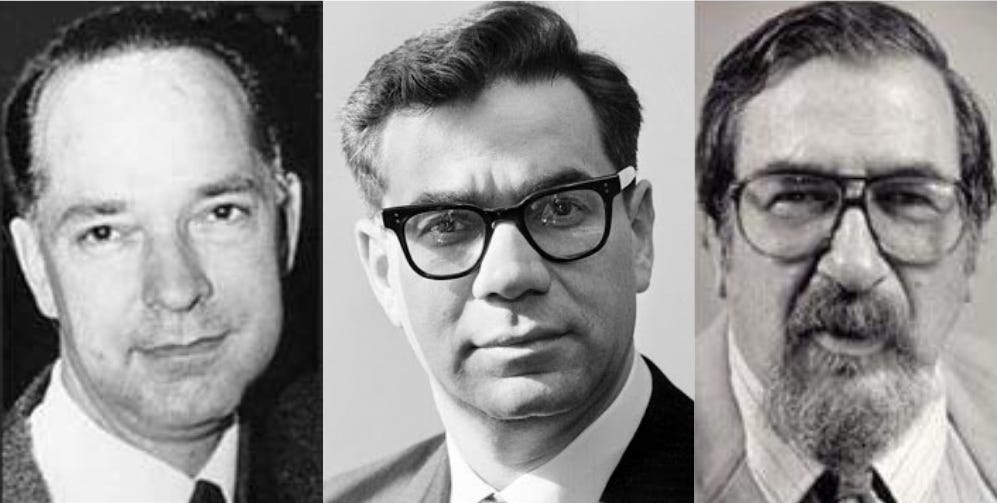
Richard H. Popkin was a skeptic with no strong partisan affiliation, as far as anyone can tell. He engaged the assassination evidence as an academic philosopher. During his career, Popkin held positions at Columbia, the University of Iowa, and UC San Diego. Though he was Jewish, active in Jewish organizations, and an expert in Jewish intellectual history, Popkin never seems to have been an activist.
Instead, Popkin wrote a scholarly critique of the Warren Report that systematized reported sightings of Oswald-like men in places that were inconsistent with Oswald’s known movements. During Oswald’s sojourn in the Soviet Union, J. Edgar Hoover had warned the State Department that an impostor could use Oswald’s birth certificate and identification details while he was in the Soviet Union. Popkin cast doubt on the authenticity of the memorandum, suggesting that it had been a reconstruction on the day of the assassination.
Popkin previewed his ideas in a New York Review of Books article followed by a book, The Second Oswald, in 1966. That same year, Harold Weisberg, a committed leftist and former Senate investigator who had been fired for leaking to the press in 1939 and then from the State Department over his politics in 1947, published Whitewash, the first of eight books on the assassination.
Weisberg attacked the single-bullet theory, alleged that a conspiracy had tampered with the autopsy and hid the true results, and complained that evidence had been mishandled. He avoided grand conspiracy theories, however, and this lent his partisan spin a quasi-scientific veneer of credibility. By the 1990s, Weisberg was the acknowledged dean of assassination conspiracy researchers.
Before he died in 2002, Weisberg’s penultimate book was Case Open: The Omissions, Distortions and Falsifications of Case Closed. It is a polemic against Case Closed: Lee Harvey Oswald and the Assassination of JFK, the 1993 book by Gerald Posner. About 40 percent of Posner’s book is the biography of Oswald. In our interview, he noted that none of these four conspiracy theorists, least of all Weisberg, ever bothers to examine Oswald. They look right past him.
“In many of the conspiracy books … Oswald’s sort of a cipher”, Posner told me in our podcast. “He’s a stick figure who you just don’t know anything about him, and you assume that this just turned 24-year-old kid could not possibly have done it.” That story is too unsatisfying for too many people. “We want something bigger on the side of the killer. It makes us feel that life isn’t random. A conspiracy does that very nicely”, Posner said.
Indeed, Oswald tried very hard to suggest a greater conspiracy existed by calling himself a “patsy” in his Dallas police interview. He denied the photograph of himself holding his carbine in his backyard was real. Despite his wife Marina’s confirmation that she took the picture, photographic ‘experts’ found shadows allegedly out of place in 1978. Modern analysis has concluded the shadows are physically consistent. The more interesting point is that Oswald wanted to enter a plea of not guilty.
Posner believes that Oswald would have used his moment of fame, and his inevitable guilty verdict, to become a political prisoner and call attention to his anarchist-inflected take on communism. “Oswald loved the limelight”, Posner said in our podcast. “He always thought he was smarter than he was. He was clever, but he thought he should be the center of attention.”
To use a 21st century word, Oswald could only become “relevant” and “stay the center of attention if he continued to say, ‘It was something larger than me.’” It happens that Posner also wrote Killing the Dream: James Earl Ray and the Assassination of Martin Luther King, Jr., published in 1998.
He thinks Oswald would have been like James Earl Ray, King’s assassin, who claimed that a mysterious man named Raoul had been involved in the plot. Ray managed to string along many prominent believers, including some members of the King family, with falsehoods until his death. It was a power trip for Ray, Posner says, and Oswald would have been the same.
Three years after the assassination of John F. Kennedy, the conspiracy theories that absolved Lee Harvey Oswald had already assumed their basic forms. As we have seen, at least three-quarters of this process was political, while no more than one-quarter of the impetus was ever a rationalist inquiry.
Roger Stone is no communist. He is instead a ‘right wing’ political operator who once paid Al Sharpton to run for president as a Democrat. John Farrell observed in 2019 that Watergate made Stone into what he is, while Donald Trump completed Stone’s evolution into his present form. If you made up a conspiracy theory about a conspiracy theorist, you would invent Roger Stone.
Stone has his own book of JFK assassination lore, The Man Who Killed Kennedy: The Case Against LBJ. Oswald conspiracy became acceptable on the right, where it is useful against the historical narrative of the Great Society and a handy explanation for the Vietnam War. As we have seen, however, it all started with leftists who could not handle one of their own killing a popular liberal president.
The Oswald conspiracy theories are, and have always been, a psychological operation by political actors. Motives have become as varied as the human condition, but the entire historiography of Oswald conspiracies avoids looking at him for a very simple reason.
Along with Case Closed, Posner’s book, one might read Norman Mailer’s 1995 true crime classic Oswald’s Tale: An American Mystery, the definitive biography, and come away convinced that he did it. Try as hard as they might, no researcher has ever managed to put a different name behind the trigger.
Look away from him, and you will find whatever you were looking for in the first place, something that isn’t Lee Harvey Oswald. The same is true for Jim Jones, who has been presented to the public as a religious leader rather than a communist cult leader. Leftist violence never belongs to the left, because the left tells us so.