
Francesca Hong, a failed restaurateur and Democratic nominee for governor in Wisconsin, had a mental breakdown at 18. “ I didn’t actually walk at my high school graduation because I had been hospitalized for a week at a child psychiatric hospital”, she told Meal Magazine in 2023. “I just felt like nothing had meaning anymore.”
Hong’s experience is common in female adolescence. “It was a numbness that took over, and a pain that I couldn’t describe. I couldn’t feel anymore, and that scared the hell out of me. And I found myself self-harming to feel something.” She was cutting herself and unable to function.
“I was diagnosed with bipolar disease. I was taking SSRIs and I’d overdosed on lithium. I didn’t know why I couldn’t connect with people deeper, and that pushes you into isolation.” Hong says she got better, and became an independent adult, by working in a restaurant.
There, she found people “from so many different backgrounds and life experiences, and the best restaurant teams take care of one another so that you don't have to think about if you belong here or not.” Immigrants like her own parents, for example. Hong explicitly identifies with the DSA wing of the Democratic Party, the young communists.
“And between women and people who identify as non-binary, there's this group of phenomenally underrepresented folks in the food and beverage industry”, Hong told her interviewer. Hong spoke of her restaurant business as a collective, “we”. “Specifically, women, women of color and non-binary folks who don't often see themselves as leaders in an industry”, Hong responded when asked to explain.
“The most compassionate, hardworking people are just not valued and seen in an industry that's supposed to value and see everyone, because food is for everyone.” Hong ascribed this ‘found family’ identity, this sense of ‘solidarity’, to the galvanizing effects of the first Trump administration.
“He affirmed that we had all been very complacent and comfortable”, Hong told a food magazine(!). “And I don’t think democracy is supposed to be comfortable if it’s operating in the right way. It definitely shouldn’t be comfortable for the folks who have been in positions of power.”
“We need to start giving people money”, Hong said, pronouncing the lessons of covid, for “they will know what to do with it.” We must eat the rich and redistribute their flesh to the masses. As a failed restaurant operator, Hong will be the perfect governor to have Wisconsinites eating each other in no time at all.
Magical thinking
“Restaurants can be a sustainable industry”, Hong said, uttering the power-word of the green new deal. “Community” and “communities” need sustainable restaurants like her own.
Hong’s marriage on the other hand proved unsustainable. “We didn't make enough time to honor each other as individuals because we were so immersed in the restaurant and our child.” The separation left Francesca Hong free to focus on politics.
Her restaurant was also unsustainable. Hong had to rent a restaurant kitchen in order to shoot a campaign ad in her run for the state house. Her solution to the inequalities of the restaurant trade is political.
“I am competing with ghost kitchens, I am competing with fast-casual, I am competing with Mark [Cuban] investing in restaurant tech that I will never be able to afford, and I’m being priced out”, she complained in 2023.
I think the restaurant industry is reliant on income inequality, and it is absolutely reliant on the wealthy becoming wealthier. The nuances of inflation are also that those who are controlling a lot of the supply chains dictate the cost, and consumers absorb that cost. So capitalism has not been working for consumers or workers. There has to be transformative change in those economic structures, and it’s going to come from more people fighting for economic justice. It starts with increasing wages and giving people agency over their wages, and then ensuring that the costs of childcare, transportation, housing, and education are seen as a public good, and that government itself can be used for good. It is a systems change that needs to happen. I am a business owner who is anti-capitalist because I know that for a business my size, I am no longer competing with other businesses my size.
If the reader has encountered an ordering kiosk at McDonald’s, they will already have seen how the economics of wage inflation, measured in higher minimum wages, has played out in the fast food industry. Franchise chains of all types have been squeezed between the rise in supply chain costs and the rise in wages. The results are automation, rebranding, cost-cutting, and the disappearance of the dollar menu.
Of course, by “those who are controlling a lot of the supply chains dictate the cost”, Hong means capitalism. Capitalism is the problem that she intends to fix for Wisconsin (“systems change”).
In 2023, she had evolved beyond the laws of supply and demand because she was no longer in competition with other businesses like her own, somehow. This is an economic theory born of cognitive dissonance, which is to say it is crazy talk. Hong is mad, and mad about her restaurant.
To recap, Francesca Hong began self-harming; was diagnosed as bipolar; had a mental breakdown; overdosed on lithium, and had to be hospitalized. Her adult origin story begins there.
After her divorce, her restaurant failed, so she went into politics, where she can seize the means of food production and redistribute them to marginalized communities. The nonbinaries will be first in line, apparently.
“Wisconsin is what I call a petri dish for authoritarian tactics,” she told her interviewer. She said she was talking about Trump, but I say Francesca Hong was telling us about herself. She gave Wisconsin fair warning of what she really is.
How to go crazy as a Democrat
To be fair, it is refreshing to see a Democratic Socialists of America candidate that actually comes from the working class, who is not a curated ‘working class’ candidate like Graham Platner. Her genuine class identification, as well as her ethnicity, are catnip to liberal Democrats, who will excuse or overlook her evident intentions to destroy liberal civilization.
Indeed, by recalling her youthful mental health episode, Hong ticks off yet another ‘identity box’ on the intersectional checklist. Diagnosis has become identity. Mental illness is depathologized, even celebrated, by the modern ideological left. Leftist politics produces a social dynamic where individuals or groups subconsciously or overtly compete through suffering.
In social psychology, this phenomenon is called competitive vulnerability. Within the intersectionalist paradigm of the modern American left, the severity, rarity, or extremeness of any medical, psychological, or social diagnosis is its currency for validation, moral authority, or social standing. Pathology becomes a quality rather than a red flag.
Liberal institutions, especially the academy, reinforce this problematic trend by treating diagnoses as protected identity categories in ways that mirror the identity frameworks of race, sexuality, and ‘gender’. Speech is policed to prevent ‘harm’ to this new minority, which receives special accommodations.
Jason Arday, the youngest professor in the history of Cambridge, is an evident plagiarist and fabulist, but the elite professors who elevated him now defend the poor, “autistic” man. Leave him alone, you racist neurotypical bigots!
However, the elevation of self-identification over clinical assessment also happens across the social media landscape, where the intellectual viruses of woke spread from the Wuhan wet market of Tumblr over a decade ago.
TikTok has accelerated the rate of rapid-onset identification with conditions such as ADHD, autism spectrum disorders, dissociative identity disorder, Tourette’s-like tics, and other, often trauma-related, labels. ‘Neurodiversity’ has become an entitlement to claim discrimination, marginalization, and oppression.
This is why America has seen a sharp rise in self-diagnosed cases of mental illness among adolescents and young adults, often without formal evaluation. The label then becomes a core part of how someone narrates themselves: they are always ‘speaking as an autistic person’, or ‘as someone with complex post-traumatic stress disorder’. Saying ‘no’ to such a person is ‘ableist’.

Pop culture understands these as expressions of identity when they are actually identities in formation. While this discourse makes room for medicalization, it is voluntary, a matter of body autonomy rather than evidence-based medicine. The schizophrenic may need medication, but he cannot be made to take it, because that would be fascism.
We cannot ‘cure’ autism, or mental illness, or gender dysphoria. Instead, we must ‘include’ these ‘identities’ in everything we do, evincing reverent respect for the minefield of eggshells that such individuals lay around themselves.
The neologism ‘nonbinary’ demands a respect that has not been earned by history. It is the crisis of meaning in young, very progressive people expressing as another western androgyny fad. It gives the game away, however, which is why the term has declined. ‘How much social status are we supposed to award the world’s first nonbinary astronaut?’ the exhausted masses wonder.
The ideology that begins with identity, that is skeptical of authority, that privileges lived experience, and that sets out to undertake authoritarian solutions, is called fascism. We are not supposed to notice that Francesca Hong is a fascist. We are supposed to believe that fascism is a purely right wing phenomenon, that when Adolf Hitler called his party “National Socialism”, he was just kidding.
Ideology however is less important in its aims than its effects. Psychologists and researchers have mapped out a precise parallel between leftist cognitive distortions and an inversion of cognitive behavioral therapy, or CBT. In other words, leftist discourse is actually, literally, no-kidding designed to make people crazy.
Cluster B indoctrination
CBT demands that the individual hold beliefs to be falsifiable and update them according to evidence. The leftist dialectic does the opposite. All information is processed through the interpretive filter of power and oppression versus the disenfranchised. Disconfirmation becomes impossible along with objectivity. Analysis becomes purely oppositional.
Greg Lukianoff and Jonathan Haidt formalized this understanding of leftist discourse in The Coddling of the American Mind. The authors identify “Three Great Untruths” which directly contradict both CBT principles and long-standing psychological evidence.
An emphasis on ‘safety’ and fragility. Rather than expose someone to challenging ideas so that they learn to cope with challenges, ideas which cause discomfort, disagreement, or stress are considered a form of violence. Trigger warnings, safe spaces, and other protective devices only increase the anxiety of people who already cannot handle reality. Francesca Hong worries about a “sustainable” restaurant “community” instead of the ‘restaurant business’.
Anchoring politics in sentiment. Whereas CBT requires a person to treat feelings as data that must be tested against evidence (‘emotional reasoning’), activist and academic discourses instead elevate ‘lived experience’, meaning subjective experience, over empirical evidence. To deny even the most trivial claim of harm is to double the harm. ‘Microaggression’ accusations assume hostile intent without evidence (‘mind-reading’). ‘Social emotional learning’ in schools allows union teachers to keep the kids in their feels during math class. Hong explicitly defends political expression as “my right to be emotional, to be personal, to be human”, to be “angry, frustrated, and scared”.
Identity politics frame the world as a stark moral landscape. Life is a battle between the good people and the evil people. CBT on the other hand relentlessly attacks black-and-white, us-versus-them thinking. Identity-political framing routinely sorts people and institutions into oppressor/oppressed binaries, treating disagreement as moral contamination rather than disagreement, stirring perpetual conflict, making impossible any a nuanced response to any problem, because every problem is political.
Every issue is a catastrophe because all issues are bound together: climate justice is racial justice is gender justice is Free Palestine is plastic straws. The omnicause creates anxiety through this binding-together of issues. Every problem is the result of a totalizing, inescapable system of domination — and the only solution is to burn it all to the ground, then redistribute the ashes. The believer in such a philosophy will always be dissonant with the state of the world.
Leftist discourse encourages an external locus of control, that is, an obsession with matters outside one’s control. Rather than examine the self to admit problems, all setbacks are attributed to the structural forces outside of the individual. Hong complains that “forces that I don’t have control over” justify her hostile feelings.
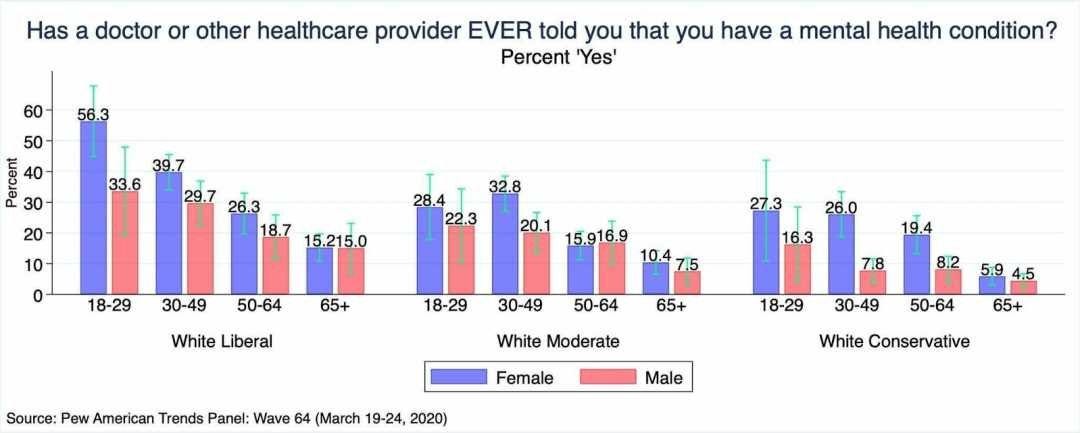
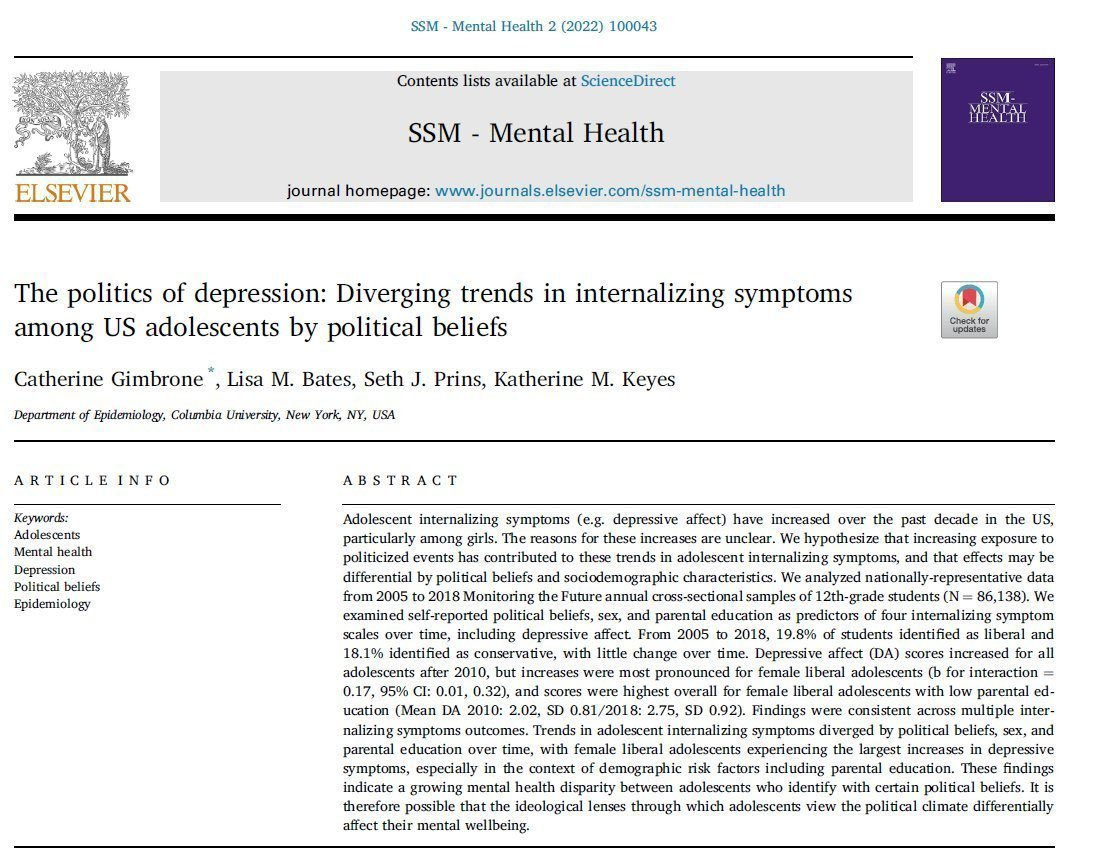
Studies repeatedly link this orientation to higher depression and lower well-being. Multiple datasets show higher rates of self-reported depression, anxiety, and less sense of personal control among the identity-politics left.
Doom becomes inevitable, to the leftist. The system is rigged against me anyway, because of my identity, so why strive? Leftist spaces personalize this self-destructive fortune-telling. Neutral or ambiguous events become targeted hate against whatever group identity is supposedly being marginalized according to the intersectional theory of oppression, fulfilling the self-prophecy.
This is, again, the opposite of CBT, which promotes second- and third-order thinking about consequences, and encourages people to take their fate into their own hands. Hong has depathologized her bipolarity, depathologized illegal immigration, and depathologized crime, too. Contrarily, her politics of who is undervalued, and what systems must change, pathologizes normality.
She is a lunatic who wants to run the asylum. “For me, what’s most important is ensuring Wisconsin has a better democracy”, Hong told her interviewer about her work as an elected state representative in 2023. “My biggest platform is through the office, but it’s also through empowering people that work in restaurants, and don’t feel seen, don’t feel valued, and absolutely deserve it.”
Economic dispossession is subsumed into a feeling of dispossession, the sense that someone else has undeserved attention. Speaking ill of a restaurateur association she despises, Hong calls them “cunts”. A “cunt” is “someone who chooses to actively harm others”, she explains. “When you know you’re being an asshole and you’re going to be an asshole anyway, you’re being a cunt.”
The world is divided into angels and devils, good people and “cunts”. This kind of thinking can make people talk and act crazy, like religious extremists, which is why I call it an ersatz religion, or a cult. Hong says this attitude comes from the “dish-pit” in the restaurant kitchen, but I say it is a product of cult indoctrination.
Oppositional Defiant Disorder
There are plenty of issues on which to disagree with President Donald Trump. One may very well find his second term disagreeable, however, and still go about their day without obsessing over his every word on Truth Social. A healthy, functional person does not wake up every day of their life with a political crusade first in mind.
The decline of liberal media outlets has been correlated with the mental health protection measures of liberals who tuned out the daily drumbeat of oppositional news after the 2024 election. I maintain that, taken as a whole, the ecosystem of liberal establishment and online media outlets seems to exist for the purpose of maintaining an unhealthy state of arousal in the news consumer.
This mirrors what I recall from the heyday of right wing and libertarian talk radio in the 1990s, or Fox News in the 2000s, so there is nothing special about liberal or leftist political news coverage doing this. We are more concerned here with the effect that such news consumption has on its daily consumers.
While I am not a psychologist, there is a useful lens of understanding from the science of the human mind: Oppositional Defiant Disorder (ODD). Primarily seen in young people, it is a clinical pattern of persistent anger, irritable mood, argumentativeness with authority figures, and vindictiveness that also characterizes the politically pickled person.
A ‘thin skin’, a temper that is easily lost, deliberately annoying behavior, spiteful sour grapes and constantly blaming other people: these are widespread, depathologized, and celebrated as moral resistance to the fascist-in-chief. Inverting the CBT principles that are used to treat ODD, the liberal is encouraged to elevate feelings over reason and adopt an extreme political line out of sheer defiance.
Problems become opportunities to oppose Trump rather than issues in need of solutions. Cognitive examination and correction of Trump-derangements are themselves demonized: ‘You only hold that opinion because you are a brainwashed MAGA, a bad person who loves the evil orange man’. Rather than persuasion, their political communication signals defiance, the only virtue that matters.
This is not an ordinary policy disagreement. Ordinary disagreement tests claims against evidence and updates itself. The ODD-like pattern instead fuses opposition into self-concept: being anti-Trump becomes a marker of moral and group identity, celebrated in progressive spaces as vigilance or solidarity.
“Trump Derangement Syndrome” is the popular shorthand for this phenomenon. It is not a formal diagnosis, of course, but a recognition that for too many liberals, reality is filtered first through the need to oppose Trump. Hong illustrates the pattern at the individual political level. Trump was her activating event. His second election was a second shock to her conscience, for it drew into question the inevitability of progressive utopia.
Trump is a “deportation machine … terrorizing our communities”. Hong sponsors ‘sanctuary' legislation to stop local law enforcement from working with ICE, creating the dangerous situations in which federal officials must confront criminals in the streets rather than a courthouse or a jail, actual ‘safe spaces’. Opposition to the polarizing figure of the president justifies every insane policy response.
Francesca Hong’s personal political narrative — the Korean immigrant-daughter outsider identity with bipolar crisis — becomes an anti-capitalist systems critique. Her political image as a foul-mouthed, working class agitator positions Trump as the authority that must be defied in order to affirm her identity.
She will use him as her excuse while we all starve to death. For if there is one thing that communists are good at, it is famine. With her magical thinking about the economics of the restaurant, Francesca Hong can starve millions, if we let her, and all in his name.
How Trump Derangement Sydrome Is Making Partisan Democrats Sick With Anxiety
Last Monday, Axios reported that nine House Democrats worry their progressive base voter is increasingly inclined to just burn everything down. The high-engagement progressive soul is unable to focus on winning back Congress in 2026, on realistic goals, on constitutional means. The people who put signs in their yards to announce their political beliefs are in full meltdown mode.


