
Osborne Ink

Osborne Ink

Home
Podcast
Skeptic Spirit
Stories
The Distance
Polemology
Archive
Leaderboard
About
The Distance

The Body Keeps The Marxist Score: Queer Theory And The Christianity Of James Talarico

Reading the favorite theologian of the US Senate candidate for Texas

Jul 10, 2026
Cross-posted by Osborne Ink
"UNLOCKED: In her books, Henderson-Espinoza does not have much to say about Jesus. Christ is merely noted as a radical bringing “militant peace” to an unjust world. The Bible becomes “trans-positive” and transgender people become “Easter icons”. "
- Matt Osborne
The Life of Roberto Che Espinoza as a Scholar, Theologian, and Activist -  Juicy Ecumenism

Roberto Henderson-Espinoza, a PhD scholar using he/they pronouns, identifies as Mestizaje, autistic, bi-polar, non-binary, transgender, and Latinx. She is all of the things, the most intersectional identity imaginable, in order to escape the “conditional whiteness” of her mixed parentage, the original sin that she rejects in herself.

Her white father was so racist that he told Henderson-Espinoza, PhD to disclose her ancestry on official forms, so that she could benefit from racial preferences in education and hiring. Robyn seeks escape from this painful consciousness of her own race as Roberto. “Especially now in the war against Black and Brown bodies, embodying whiteness on my skin has been the hardest journey of my life”, she writes in Body Becoming: A Path To Our Liberation.

This self-hatred “is the radical difference I seek to be connected with — the center of my own difference: conditionally white.” These words resonated with James Talarico, the very white Democratic US Senate candidate for Texas. After connecting with his favorite theologian on X in 2021, Talarico appeared on Henderson-Espinoza’s podcast to complain that “whiteness and masculinity” have limited his imagination.

X avatar for @jamestalarico
James Talarico@jamestalarico
@irobyn Dr. Henderson-Espinoza!! I’m a BIG fan. I read Activist Theology last year! As a progressive Christian in Texas, your work is an inspiration. I would love to talk with you!!
5:04 AM · Feb 23, 2021

1 Reply · 3 Likes

In the ensuing podcast appearance, Talarico confessed (there is no better word) that he harbored doubts about electoral politics as the solution for change in Texas. He was considering seminary, he said, because we are “running out of time” due to climate change. Henderson-Espinoza described the task of politics as “help[ing]” Republicans “have compassion”, to which Talarico reverently responded, “Yeah”.

Henderson-Espinoza uses the word “compassion” a lot in Body Becoming. She takes it to mean “suffering with” someone, an exercise in empathy. Her activism asks us all to identify with her, and then through her, to identify with everyone. “Existential and survival questions that in one sense arise out of our particularities (for example, being Latinx, queer, and biracial) are shown to be deeply important at the level of universality”, she writes in Activist Theology.

Share

Theology without Christ or God


“There is no theology without activism, and there is no activist without theology.” Her life is activism. Being queer, injecting queerness into the world, creates a theological “culture shift”, Henderson-Espinoza told Talarico in an uncanny, testosterone-affected voice. Nashville, her current home, was a place where she felt she could change things — not like Texas, her birth state, which “felt scary to me” as a “trans and queer person”.

Henderson-Espinoza’s theology is focused on liberation from “interlocking supremacies”, which we might mistake for mere intersectionalism. Body Becoming describes something more up-to-date than the Combahee River Collective of 1977: “a concept proliferating for some years now in Queer theory and other theories: assemblage.”

Critics of progressive intersectionalism call it the omnicause. “An assemblage is a collection of any number of things that may appear alike or different in their materiality that are gathered into a single new context or a singularity.” Achieving the progressive singularity requires a “diversity of tactics”, Henderson-Espinoza told Talarico. “I don’t believe in electoral politics but I still participate in them.”

Translation: Henderson-Espinoza does not endorse Antifa terrorism against law enforcement in the name of immigration justice. She merely excuses it, and continues to vote as a regular citizen. Radicalism and religion together will “dismantle and compost” the parts of the American system that offend her, such as capitalism. In Body Becoming, she writes of the “body politic” as a queered body that is “still becoming” in a perpetual state of self-revolution. Democracy should be “embodied rather than remaining an ecosystem of transactions.”

Think of it as ersatz Christian spirit, a substitute for the real thing. Henderson-Espinoza proposes to change the world-body of humanity by “transing religion … to methodologically dismantle the logic of the norm that grounds the reproduction of binarisms and theologies of complementarity.” You know: all that stuff about God making humans male and female. If we just get rid of it, the world will become a paradise where everyone loves communism.

If we just look past the plain text of scripture, the Bible becomes “trans-positive” and transgender people become “Easter icons”. In her books, Henderson-Espinoza does not have much to say about Jesus. Christ is merely noted as a radical bringing “militant peace” to an unjust world.

In Activist Theology, Henderson-Espinoza names her inspirations as Central American Jesuits Ignacio Ellacuría and Jon Sobrino as well as Marxist educator Paulo Freire. She has also named Dr. Jim Rigby, a Christian anarchist at St Andrews Presbyterian Church in south Texas, as another source of inspiration. Activist Theology calls the reader to be “contemplative in action for justice”, then describes a world of justice for free-floating “bodies”.

Many critics of woke language have noted the way gender identity activism uses the words “body/bodies” to flatten the meaning and valence of biological categories. Henderson-Espinoza extends this academic abracadabra to every progressive change project: immigration, “harm reduction”, and the “deterritorializing” of the world. Land acknowledgments abound in her books. No body is illegal on stolen land; no body should be unhoused; no body is in the wrong restroom. Black and brown bodies need liberation. Call it body Marxism.

Why Republicans are questioning the masculinity of Texas Democratic Senate  contender James Talarico | CBC News
James Talarico

Daddy issues


Activist Theology begins with a confession, repeated three times, to “white-passing privilege”, a land acknowledgement of her body. “It also took me many years to claim my heritage as a mixed-raced Latinx that, because I had been born of a Mexican woman, could benefit me as an underrepresented student.” The oppression the author experiences as an intersectional unicorn “is just a larger, more robust version of what I experienced growing up in Texas with a racist and bigoted father who hired undocumented workers to work his land and clean his house.”

“My way of protesting his behavior and bad politics was to befriend the people who worked for him”, we learn. Also, migrant workers “lured me into their house” and abused her. “Mexican men took advantage of me on my grandparents’ farm and sexually abused me for years.” She nevertheless protested to her father that he was inflicting “modern-day slavery” on migrants like her abusers. “My protest received a glare and no comment”, she remarks.

“At an early age, I denounced my father’s conservative politics, because I saw how his politics, informed by a particular orientation to theology, were harming the least of these.” The sins of the father derived from a “theology …. grounded in a particular orientation to(ward) power and control”, a “tyranny of the now” which is “the greatest evil of all in this day and age”.

This tyranny of the now is constructed by dominance and supremacy, Henderson-Espinoza writes. Overcoming this tyranny requires “divesting from the economic supremacy of capitalism and seeking to ensure that all have access to the resources necessary for not just surviving but thriving”, i.e. communism.

Henderson-Espinoza is not shy about this. She recommends The Motorcycle Diaries by Ché Guevara and works to “dismantle the worship of the all-American dollar” by overcoming “supremacy culture”. She has traveled to Cuba to see the underdog for herself, talk to “history professors, seminary professors, Cuban LGBTQIA activists, community folks, and my dearest intellectual compañera”.

She came away convinced that “systemic oppression and State-sponsored violence against black and brown people” mean there is “no hope in the current system as it is.” The United States must be overthrown to end the tyranny of the theology of power and control, the demiurgic force of evil in the world.

Activist theology confesses that the yoke of empire illustrated by and through the parasitic relationship of militarism, racism, and capitalism has curated the public religion of white nationalism that is deployed through technologies of Christian supremacy and whose liturgy is a cultural [sic] of violence, which is so often State-sponsored.

This theological tyranny extends to the author. “I have always been damned by the church because of their positions on sexuality and gender, insistence on a monoculture that fortifies heteronormativity and homonormativity, and their general sex-negative ideology.”

Henderson-Espinoza also had a late-life diagnosis of autism, adding “the complexity of having a brain that is neurodivergent” to “a body that is Trans and Queer, creating a lot of confusion for trying to navigate a cultural body of dominance that has no room for someone like me.” The world has no place for her.

Testosterone eucharist


“In leaving the church, earning a PhD, coming to terms with who I am as a NonBinary Transgender Latinx, dosing testosterone each week, deepening my antiracist awareness, and learning about embodiment, I’ve encountered a lot of change”, we learn in Body Becoming.

Per the title, “becoming” is the active idea in the book. “We must leave the politics of representationalism aside and lean into the revolutionary politics that create conditions for democracy to be rooted in our own stories of becoming”, she writes. These revolutionary politics express in her Sunday ritual of testosterone microdose injections, which she describes in cozy detail. “Testosterone is a hormone, but I refer to T as a necessary vitamin for my survivability”, Henderson-Espinoza says. She would literally die without it.

“Assigned and labeled female at birth, I have grown into adulthood believing I am neither male nor female. I transcend the static gender binary.” Belief in the resurrection is gone, belief in personal revision is absolute. Truth is found in “top surgery, where my chest will be differently contoured and I will fit more easily into my body.” A double mastectomy to cure her cancer of the gender binary.

Rejection of her own sexed body is rejection of what made her mother weak, passing on the abuse she experienced. “I go to therapy every week to stay sane in a world that discounts people who look like my birth mother.” Then “when I saw the heteropatriarchy in the church, how women were marginalized and minoritized bodies were treated, I wondered how different the church really was from my very secular white father.” In becoming an “old man”, Henderson-Espinoza replaces his paternal wisdom with her own, better wisdom.

Taking testosterone changes her, which changes the world. She quotes Chicana feminist author Gloria Anzaldúa: “I change myself; I change the world.” This “becoming” is “an immanent process”, she writes, meaning it is intrinsic to the quality of trans-ness. Where this quality comes from is not explored at all.

Becoming “is that thing that is with us at all moments and is all around us, not transcendent and intangible, though it might feel as though it is out of our tangible reach. Becoming is that thing that produces the kind of systemic and molecular change that we want to see in the world.” Like the Force, but with testosterone injections.

What seems obvious to this reader, that was unacknowledged in Body Becoming, is how the author’s passion for protest culture extends to her own body. “I’ve been to my fair share of protests, from my days living in Chicago, when I attended protests for LGBTQIA rights and workers’ rights, to protests while I lived in Denver during the Occupy movement, protests demanding better treatment for immigrants, and protests fighting white supremacy that included the August 12, 2017, protest in Charlottesville, Virginia.”

“Theology became the frame of protest for me”, too. Oscar Romero, the Catholic priest who was gunned down while giving the eucharist in El Salvador during the 1980s; Michael Brown and Trayvon Martin; Henderson-Espinoza lists her admired martyrs in Activist Theology.

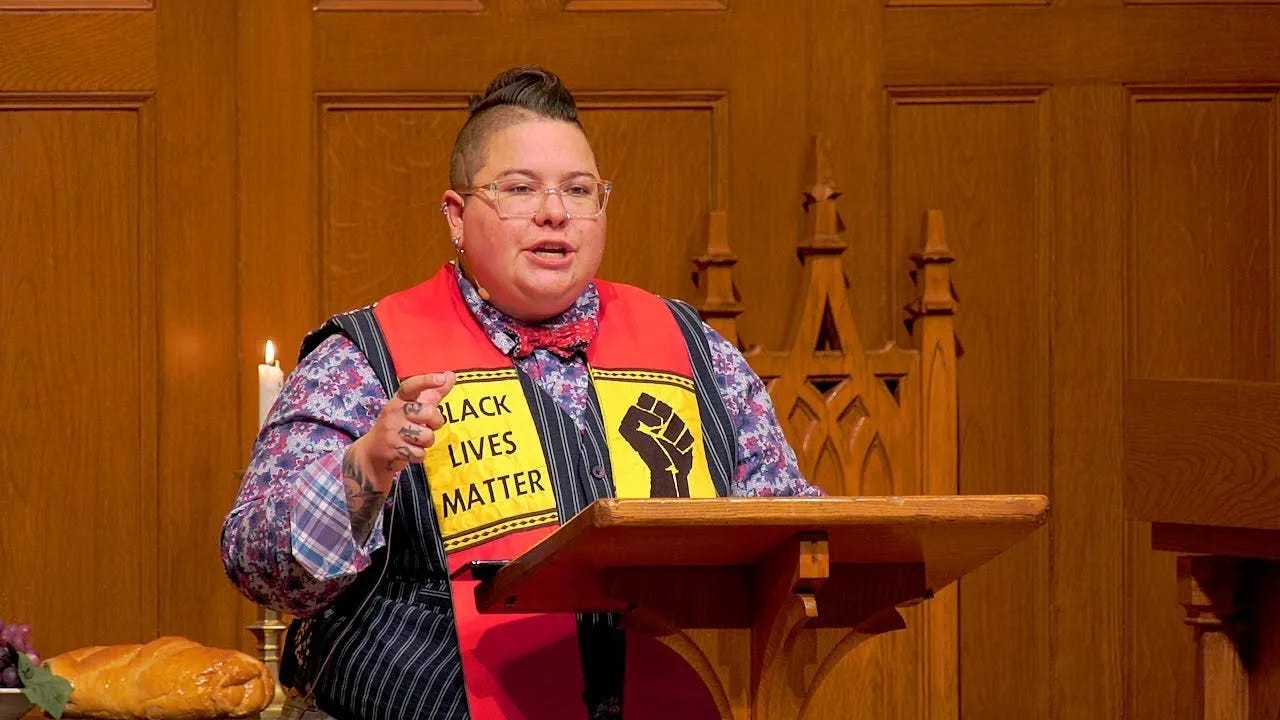
In Body Becoming, she becomes a martyr herself. She mortifies her flesh with medical assistance. She receives hate mail after standing against white supremacy at Charlottesville in 2017 while wearing her Black Lives Matter stole: “ there are material consequences for the hate we embody”. She had to watch on television as protesters gathered around Capitol Hill on 6 January, 2021. As much as she loves a good protest, Henderson-Espinoza is dismayed to see this protest, for it is clearly white supremacy in action.

“Enfleshing freedom”


In “becoming”, Henderson-Espinoza is “enfleshing freedom” on our behalf. This is an explicitly theological project to correct past wrongs. “The body was written out of the faith and then further demonized by Greek thought”, we learn in Body Becoming. God has been misunderstood by white men.

Defenders would say this is prophetic Christianity updating for marginalized bodies, in the spirit of Jesus and the prophets, but Henderson-Espinoza has little to say about God unless she is destabilizing, dismantling, and deconstructing Him.

“In the language and lens of animism, [God] is the cognization and awareness that all things are endowed with spirit and life, something that Christian theology erased and never incorporated into the life of the church. Whatever our orientation to this microscopic and macroscopic movement, we can call it becoming.”

Body Becoming is an explicitly political book. “I didn’t set out to write a book on democracy, but the more the United States began to reveal how precarious our current democracy is, the more I felt compelled to consider definitions of democracy and varying critiques of democracy within the field of political theory to help me rethink democracy.”

Henderson-Espinoza would see this rethought democracy — communism — “enfleshed” in the body politic. “I also write as a theologian and as a storyteller who believes we have to imagine our own being rooted in our material bodies so that democracy can also be embodied rather than remaining an ecosystem of transactions.” We must evolve past the capitalist production of bodies to the socialist redistribution of bodies.

“From a policy and political level, we discourage movement” of bodies, Henderson-Espinoza asserts. People are too stuck to their jobs when they could be free to adopt nomadic ways like herself. “We need to destabilize the settler mentality so that we can shape and shift our current vision of democracy into one of multiplicity and difference.” This will also be good for the undocumented, of course.

Destabilization is holy. “The best gift I’ve ever received to guide me toward my own embodiment was my bipolar II diagnosis”, Henderson-Espinoza says. Also: “I am neither conservative nor liberal, neither progressive nor traditional; I am a liberationist and am invested in the logic of liberation.” It is solipsism as liberation theology, however, yielding a solipsistic liberation.

This theology is perfect for the pursuit of ‘embodiment goals’, which was the original purpose of ‘gender medicine’ and has become its final form again. Phrases that worked a spell on people just a few years ago, when these books were written, have already lost their currency: ‘life-saving’, ‘suicide prevention’, ‘the science is settled’.

Stripped of pretensions, Henderson-Espinoza offers the same justification as Andrea Long Chu, who famously demanded to have a vaginoplasty even though he knew it would not make him happy. Her “becoming” is his demand to have the vaginoplasty he wants, even though he knows it will not make him happy.

‘Born in the wrong body’ has been the most common metaphor of dysphoria. There is no dysphoria in the work of Roberto Henderson-Espinoza, PhD, and “he/they” does not use this phrase. Indeed, she criticizes Cartesian dualism that separates body from mind. Her “theology of becoming” is a purposeful transformation of the body rather than a correction.

James Talarico, the Senate candidate, has approved of this “becoming” in children, before. He voted against a bill to ban pediatric transition in 2023, calling it a “dangerous” manifestation of “Christofascism”. Now Talarico says that “I oppose gender reassignment surgeries for minors”, though he still campaigns with a surgeon who admits enfleshing the freedom of minor girls who want their own becoming.

The critique of transgender ideology as a species of cult is commonplace. Families report cult-like behaviors in children; detransitioners report cult-level thought control; a community forms a cult around the ‘trans child’. This cult has a theology, rituals, and practices. It has a sacred “becoming” in a central myth of the self, an ersatz Christianity that only a Democrat could love.

The Distance

The SPLC Funded The Hate It Sold To Donors

Matt Osborne
·
Jun 4
The SPLC Funded The Hate It Sold To Donors

“Although the SPLC has indeed done some good work in the past and still does some good work today, it has proven, time and time again, that it cannot be trusted in the business of identifying hate …

Read full story

No posts

© 2026 Matt Osborne · Privacy ∙ Terms ∙ Collection notice
Start your SubstackGet the app
Substack is the home for great culture