

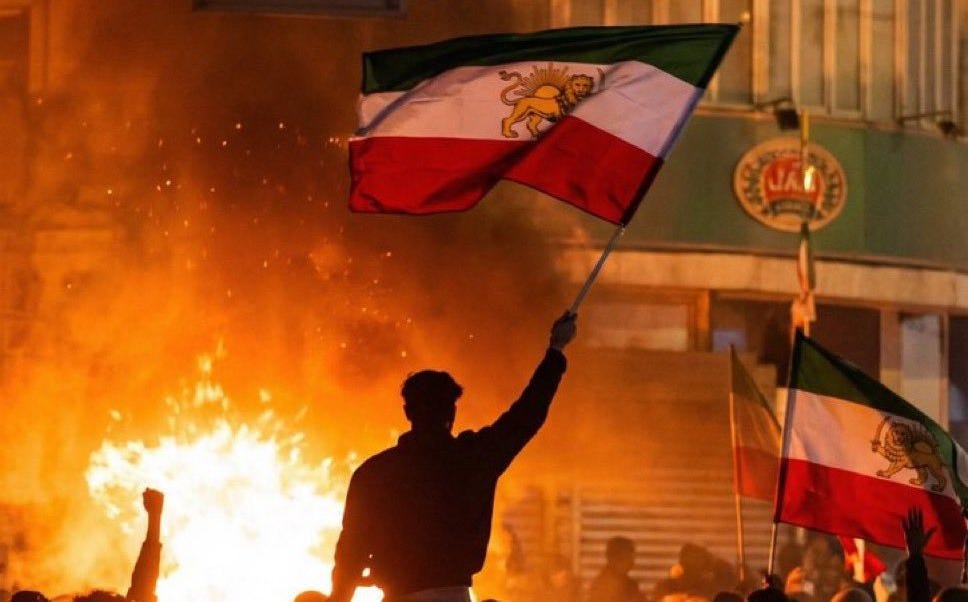
The scenes from Iran are consistent with a regime in terminal crisis. Reza Pahlavi could very well return to power in some sort of transition to an efficient republican constitution, rather than the current Byzantine system that makes the supreme leader Iran’s only source of genuine political authority. Or the whole country could dissolve into civil war, a second Syria with more than four times the population. At least two thousand people are reportedly dead already, but it’s hard to be sure since the western press does not have a HAMAS organization to certify the numbers.
About the mosques. So far, there is not a systematic wave of arson against every mosque. Instead, the mosques being attacked and burned are the ones seen as regime symbols. I have seen some irresponsible religious expectationalism on social media. So far, there is hope for a non-sectarian outcome, which would leave the vast majority of Iran’s mosques intact. A free Iran might see a flourishing of spiritual alternatives — new Christians, new Zoroastrians, new Bahai’s — or there could be another historical wave of religious intolerance, which is what usually follows such upheavals in Iran. Do not bet your dollar on that outcome.
I do not know the future. I can only hope the future for Iran is bright. What seems certain is that the Islamic Revolutionary Guard Corps (IRGC) stands on the brink of dissolution, which would be a significant moment in the defeat of violent Islamism worldwide. President Trump has indicated he may take action against the IRGC as casualties escalate in the street battles across Iran, and it happens there are targets the United States can destroy that will incur minimal casualties, at minimal risk, with maximum economic impact on the IRGC.
Trump is reportedly getting a briefing on Tuesday, a big signal to the IRGC all by itself that he will follow through on his threat to intervene. The president will want high-value, low-risk targets that communicate to the IRGC that this is the end of the road. Perhaps this potential targeting package will come up in Tuesday’s Oval Office discussion. It might, because Trump is very focused on maritime matters, so this will be right up his alley.
The IRGC controls almost half of the official ports of Iran, about 90 out of 212, with approximately $12 billion of volume passing through their hands. In addition to these access points, the IRGC also controls at least as many illegal piers. This is one of the areas in which the IRGC has been allowed to circumvent political and clerical control of their economic activity. Altogether, “around 40% of the country’s official imports were through smuggled channels” that the IRGC control. Whereas both politicians and clerics have complained about the massive amount of smuggling the IRGC does through this infrastructure, they have been unable to do much about it.
The IRGC has meanwhile come to control an even larger portion of the capital investment economy than the clerics, using the same holding structures, called bonyads. This is also a far larger portion of the national economy than the bazaar, the ancient urban retail business guild of Iran that unleashed the current wave of protests. Trump administration sanctions against Iran’s shadow fleet appear to have resulted in the volatility of the rial, the final straw for the bazaar. Whereas the IRGC might be protected against interruptions in their cash flows, the bazaaris are not protected from the inflation caused by the exchange rates in the IRGC’s underground economy.
Iranian officials refer to this model as their ‘resistance economy’ (eghtesad-e moqavemati), which Supreme Leader Ali Khamenei codified in his ‘General Policies’ of February 2014. It is in fact an unaccountable slush fund that the IRGC has used to fund Iran’s overseas proxies. It is important to recall that the IRGC has a very different mission than Artesh, the Army of Iran, or its naval component (IRGCN is the naval IRGC), which exist to defend the territory of Iran. We must recall as well that Artesh sat out the 1979 Revolution, which is why the clerics created the IRGC as a parallel military organization in the first place. Within Iran, however, IRGC is largely an economic organization, with economic vulnerabilities. These should be the primary focus of American mission planners, I argue, because they are supreme vulnerabilities that have immediate impact on the economic power of the IRGC.
For example, the IRGC has specific infrastructure at Bandar Abbas port. These buildings can be identified and targeted during nighttime hours to reduce potential civilian casualties while sending exactly the right ‘message’. But the illegal piers present the most opportunity, in my opinion. First, because they are illegal even in Iran; they are simply not supposed to exist at all, so they enjoy no protection whatsoever from international law. Second, because at least some of these piers can be smashed with standoff munitions, at minimum risk to everyone involved. Third, because attacking half the IRGC’s import economy this way would be far cheaper and infinitely more efficient than an old-fashioned blockade.
It is likely that in the wake of such strikes, the bazaar would redouble their efforts. Iranians are already renaming streets with stickers that have Donald Trump’s name. If he started punishing the IRGC in this way, they would probably put his name in gold letters on the Grand Bazaar. Set this aside, however, because the freedom of Iran is more exciting than any president. The IRGC simply cannot survive infinite humiliations. Bazaaris would smell blood and act accordingly if the United States took military actions to strangle the IRGC.
Trump will want simple and effective options like Midnight Hammer, the B-2 flight that destroyed Iran’s underground nuclear facility. While I do not know what Pentagon planners have in mind, there are crucial IRGC targets they can, and probably will, identify for the president — targets that do not require World War III, beachhead invasions, ‘boots on the ground’, carpet bombing, or calling upon the ghosts of Afghanistan like Aragorn in Return of the King. A minimalist military approach is exquisitely possible, and frankly ideal to all parties. Serious blows to the IRGC’s economic power would likely prove decisive because they already are.
Very brave Iranians are doing all of the dying for Iran, right now, but no Americans should be put at risk to help them. They would like help, but they have to finish this on their own — and then who knows what will become of Persia. Change is coming. Maybe Trump can cut the bleeding short and give Iran the best chance for a new beginning in freedom.